In This Article
- What a 1.5 Carat Diamond Really Is (and how it looks on your hand)
- Use the Four Cs, But Put Cut First (Cut Quality, Colour, Clarity, Certification)
- Price, Value and Lab-Grown Alternatives: Stretch Your Budget Wisely
- Settings, Shapes and Practical Buying Tips (including real-life scenarios)
- A Quiet Rule for Choosing Well
- Explore Lab Diamond Jewellery You Can Actually Wear
You might remember the moment you first tried on a ring that felt just a little too large or too small; I do. That awkward thrill is why a 1.5 carat diamond often feels like the Goldilocks option: not showy, not shy. If you’re open to lab-grown, 1.5 carats becomes a design choice rather than a budget ceiling.
In this guide you’ll get straight-to-the-point advice on what a 1.5 carat diamond is, how to judge sparkle versus size, and how to stretch your budget without sacrificing the wow factor. Expect practical tips, a couple of slightly opinionated asides, and one hypothetical you didn’t see coming.
What a 1.5 Carat Diamond Really Is (and how it looks on your hand)
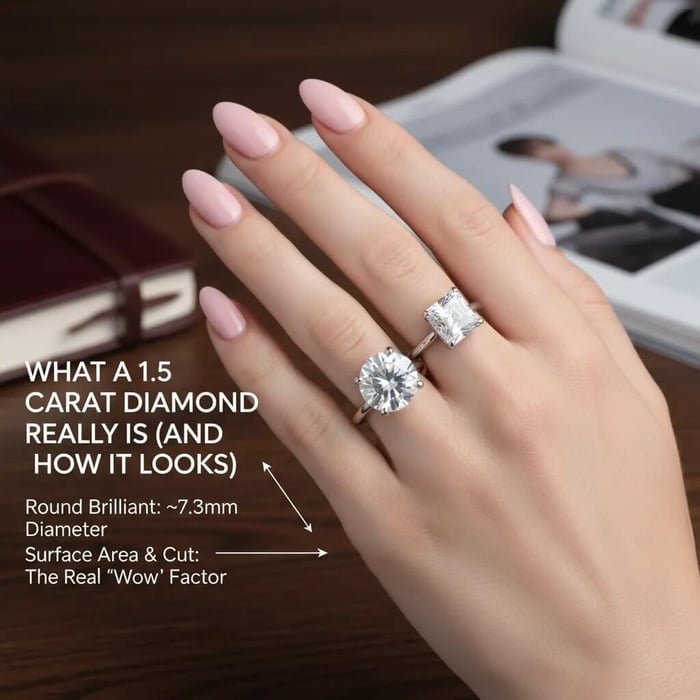
A 1.5 carat diamond is one that weighs 1.50 ct (0.30 grams). Carat is a weight, not a direct measure of diamond size, so two stones with the same carat can look different on your finger.
How big is a 1.5 carat Round Brilliant in real life?
If you choose a Round Brilliant, a well-cut 1.5 carat diamond typically measures about 7.35 mm in diameter. On your hand, that usually gives you a clear presence and sparkle without feeling “too much”, especially if you have smaller fingers.
Rule of thumb: 1.5 carat often sits in the sweet spot, large enough to feel special, still wearable every day.Why “looks bigger” is about surface area (not decimals)
When you’re judging size, focus on surface area (the face-up spread you see from above) and the quality of the cut. A diamond can carry weight in depth, which reduces the visible spread. That’s why two 1.50 ct stones can have different “wow factors”.
- Cut drives sparkle and can also affect how large the stone appears.
- Depth % and Table % influence face-up spread and light return.
- Setting matters: a halo or thin band can make the centre stone look larger.
Lily Lab Pear Diamond Solitaire Engagement Ring 1.50ct G/VS 18k White Gold

£1,435.00
£2,486.00
Fall in love with the captivating Lily Lab Pear Diamond Solitaire Engagement Ring, handcrafted in the UK with 18k white gold. This ring features a beautiful 1.50-carat G/VS-graded lab-grown diamond certified by IGI. With a UK hallmark and a lifetime… read more
A slightly nerdy aside: same carat, different shapes
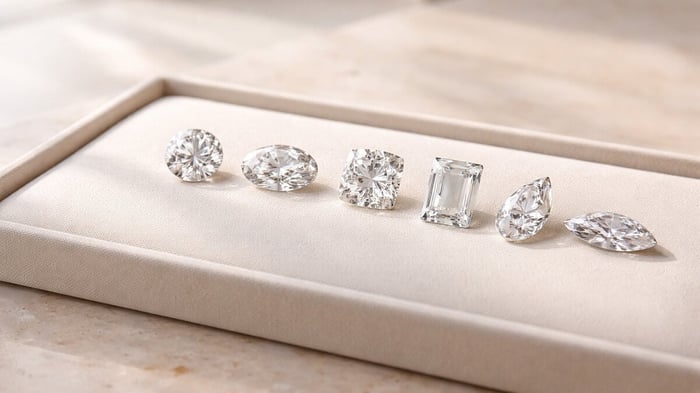
A 1.5 carat diamond in a princess cut won’t look the same size as a round because the shape uses weight differently. The princess cut often has more depth, which can reduce face-up size compared with a well-proportioned round. For fancy shapes, you’ll also see a L/W ratio (length-to-width), which changes the outline and how much finger coverage you get.
Specs you’ll see on product pages (and what they hint at)
Listings for diamonds often include terms like:
- Light Performance (sometimes Light Perf.)
- Polish
- Symmetry
- Depth %
- Table %
- Crown Angle
- Pavilion Angle
- Lower Girdle Measurements
- Fluorescence
- Eye Clean
If you want a 1.5 carat diamond to look its best, prioritise strong light performance and balanced proportions over tiny changes in carat weight.
Use the Four Cs, But Put Cut First (Cut Quality, Colour, Clarity, Certification)
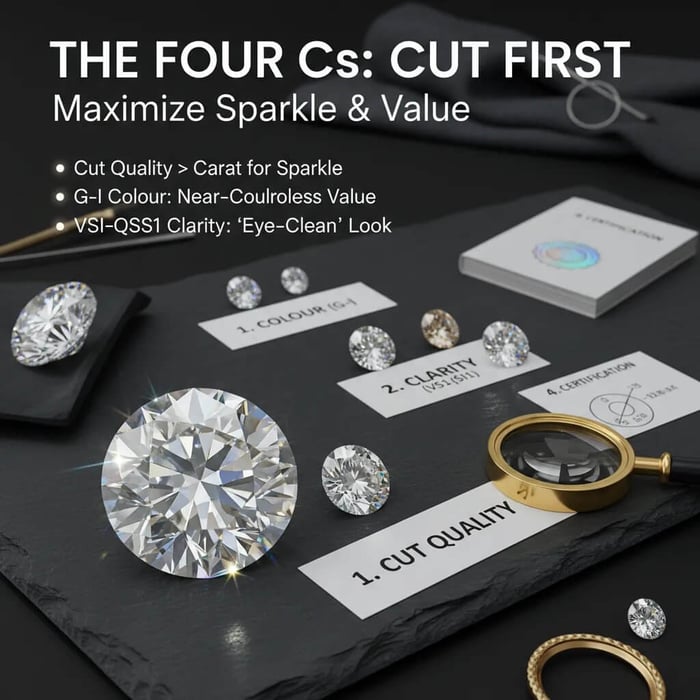
When you’re choosing a 1.5 carat diamond ring, the Four Cs (Cut Quality, Colour Grade, Diamond Clarity, Carat Weight) help you compare stones fairly. But you’ll get the best results if you put Cut Quality first, because it controls how much light the diamond returns to your eye.
Cut Quality: the biggest driver of sparkle
A 1.5 ct diamond can look dull if it’s cut too deep or too shallow, even if the colour and clarity are high. Cut quality often maximises sparkle more than carat size alone, so prioritise a cut grade of "excellent" or "very good" for strong brilliance and fire.
Cut dictates brilliance. You’ll notice a poorly cut 1.5ct long before you notice a slightly lower colour grade.If you’re comparing similar diamonds, check the report details, such as polish, symmetry, and proportions (depth%, table%, crown, and pavilion angles). These small numbers affect how lively the stone looks in real life.
Colour Grade: aim for value, not perfection
For most settings, G–I is the sweet spot. These colour grade options usually face up near colourless, especially once set in a ring, while keeping costs down compared with D–F. If you’re choosing yellow or rose gold, you can often lean towards H–I without seeing obvious warmth.
Diamond Clarity: choose “Eye Clean” over “flawless”
With Diamond Clarity, you’re paying for what you can (or can’t) see. In a 1.5 ct stone, inclusions can be easier to spot than in smaller diamonds, so target VS1 to SI1. Many diamonds in this range look eye clean, meaning you’ll rarely notice inclusions without magnification. Ask to confirm eye-clean status from a normal viewing distance.
Certification: the “Fifth C” you shouldn’t skip
Certification protects you from guesswork. Always choose a diamond with an independent lab report from GIA, AGS, IGI or an equivalent respected lab, so you know the cut, colour, clarity, and measurements match what you’re paying for.
| What to prioritise | Recommended range |
|---|---|
| Cut Quality | Excellent or Very Good |
| Colour Grade | G–I |
| Diamond Clarity | VS1–SI1 (aim for Eye Clean) |
Price, Value and Lab-Grown Alternatives: Stretch Your Budget Wisely
Understand the 1.5ct price range (and why it varies)
A natural 1.5 carat diamond ring can feel like a big jump in spend, and the spread is normal. Lab-grown diamonds give you similar, or better, visual impact for less money, which can let you prioritise cut quality or a more refined setting.
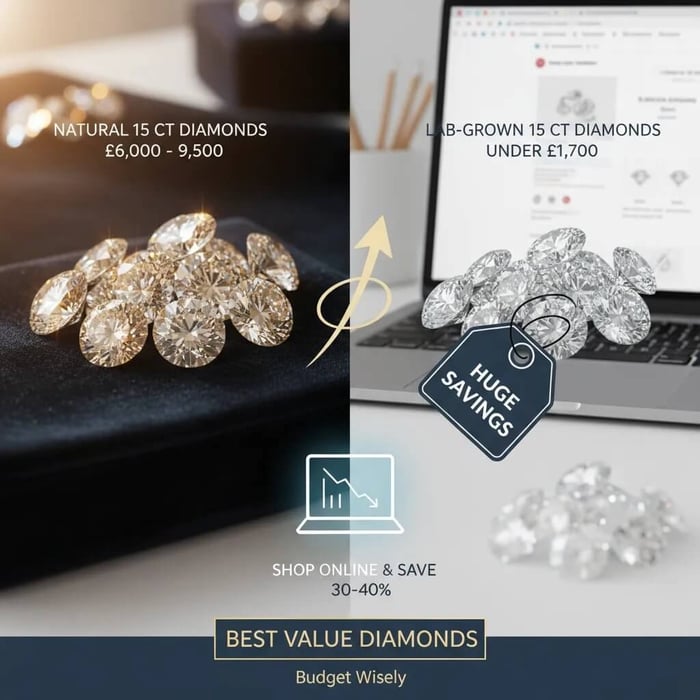
For best value, you’ll often see good-quality natural stones priced around £6,000 to £9,500. The difference usually comes down to cut quality, colour, clarity, and certification, two diamonds can weigh the same but look (and cost) very different.
| Option | Typical price | What you’re paying for |
|---|---|---|
| Natural 1.5ct (best value range) | £6,000–£9,500 | Rarity + traditional resale market |
| Lab-Grown Diamonds (1.5ct) | Under £1,700 | Same look for less; made in a lab |
Consider Lab-Grown Diamonds for maximum visual impact
If you’re cost-conscious, lab-grown is the fastest way to keep the 1.5 ct look without the natural price tag. Many Lab-Grown Diamonds at 1.5 ct come in at under £1,700, which can free up budget for a better cut, a nicer setting, or a larger centre stone.
Buying online and considering lab-grown options can transform your budget, without losing the brilliance that matters most.Use online retailers to find the best value
Shopping with reputable online retailers can sometimes be 30–40% less expansive compared with many local jewellers, mainly due to lower overheads and wider stock. You can also compare certificates and specs side-by-side, which makes value easier to judge.
Eva Lab Diamond Halo Cushion Engagement Ring 1.50ct G/VS in 18k White Gold

£1,685.00
£2,681.00
Embrace elegance and sophistication with this exquisite Eva Lab Diamond Halo Cushion Engagement Ring, designed and crafted by hand in the UK. This ring is stunning and has a total of 1.50 carats of diamonds. A cushion cut, brilliant diamond,… read more
Budget tips: avoid “magic weight” price jumps
Diamond pricing often jumps at popular weight points. If value matters, compare stones just under the milestone, such as 1.40–1.49 ct, where a well-cut diamond can look almost identical on the hand.
- Set your target: decide your maximum spend first, then optimise cuts and certifications within it.
- Compare like-for-like: only compare diamonds with a similar cut grade and certificate.
- Spend where it shows: prioritise cut quality for sparkle, then balance colour or clarity.
Settings, Shapes and Practical Buying Tips (including real-life scenarios)
How settings change the look of a 1.5 carat engagement ring
A 1.5 carat diamond can look noticeably different depending on the settings you choose. A round brilliant at 1.5 ct measures about 7.35 mm across, but clever design can boost the perceived surface area and “wow” factor.
The right setting can make a 1.5 ct sing, halo for drama, solitaire for timeless elegance; think about lifestyle as much as looks.- Halo: small diamonds around the centre stone add width and extra sparkle, often making a 1.5 ct. look larger.
- Solitaire: clean and timeless; it highlights the diamond’s cut quality and is easy to match with a wedding band.
- Pavé: diamonds on the band increase shimmer, but check durability if you’re hard on jewellery.
- Three-stone: adds presence and meaning; side stones can balance a deeper-cut centre that faces up slightly smaller.
Diamond shapes: sparkle, spread, and the princess cut vs round brilliant
Among diamond shapes, the round brilliant is usually the safest choice for maximum sparkle because it is designed for light return. A princess cut can look bold and modern, but it may carry more depth, which can reduce face-up size compared with some other shapes at the same carat weight. For fancy shapes, pay attention to the length-to-width ratio so the outline matches what you expect on the finger.
Practical buying tips (with real-life scenarios)
Before you buy, ask for full “view details” and images, not just a single glamour shot. You want proof of performance and finish.
- Request Light Performance images and magnified photos to confirm sparkle and inclusions.
- Check Polish and Symmetry (aim for Very Good/Excellent where possible).
- Review key proportions: Depth %, Table %, Crown Angle, Pavilion Angle, plus Lower Girdle Measurements.
- Confirm Fluorescence and whether it’s listed as Eye Clean.
- Verify the certification details match the listing.
Scenario: If you commute and wear gloves often, a lower-profile solitaire or bezel-style setting can snag less than a high halo. If you want maximum finger coverage for photos, choosing a halo setting around a round brilliant diamond can provide the most significant visual lift without increasing the carat weight.
Layla Lab Diamond Halo Princess Engagement Ring 1.50ct D/VVS in Platinum

£1,965.00
£3,296.00
This Layla Lab Diamond Halo Princess Engagement Ring is a true masterpiece of sophistication, designed and handcrafted in the UK. Featuring a captivating 2.20ct of diamonds. Highlight is a 1.00 carat D/VVS certified princess cut diamond at the centre of… read more
A Quiet Rule for Choosing Well
When two diamonds look broadly similar, choose the one that performs better in real life. Brilliance is what you will notice on an ordinary Tuesday, not the fine print on a report.
Keep that principle close when you are comparing listings or weighing advice. The Four Cs rarely align perfectly at 1.5 carats, so a composed rule helps you trade off with confidence. Light performance is usually the part you live with most.
A Practical Comparison: G/VS2 Excellent vs H/VS1 Very Good
Imagine you are choosing between two 1.5 ct diamonds.
Stone A is G/VS2 with an Excellent cut grade.
Stone B is H/VS1 with a Very Good cut grade.
On paper, Stone B looks “cleaner” because VS1 sits above VS2, and it may read a touch warmer because H is one step lower than G. Yet in day-to-day wear, cut often has the louder voice.
If both stones are eye-clean, the clarity difference may never present itself without magnification. The cut difference can. Moving from Very Good to Excellent can change how bright the diamond looks, how crisp the sparkle feels, and how well the stone holds its life in normal indoor light.
So the decision becomes a matter of taste. If you are sensitive to warmth and you prefer a brighter, whiter look, you may lean towards G. If you want maximum brilliance and a more animated diamond in real life, you will often favour the Excellent cut, even if it means accepting a small shift in colour or clarity on the certificate.
As you narrow your shortlist, do not let the report make the decision for you. Ask for light performance details, confirm eye-clean status, and compare how each stone actually looks. That is how you end up with a 1.5 carat ring you will love not just on the day, but every day after.
Maya Lab Diamond Bezel Solitaire Engagement Ring 1.50ct D/VVS Platinum

£1,385.00
£3,821.00
Celebrate your love with the Maya Lab Diamond Bezel Solitaire Engagement Ring, handcrafted in the UK. This beautiful ring features a round, 1.50 carat D/VVS-graded lab-grown diamond, bezel-set in platinum. IGI certified and UK hallmarked, this ring comes with a… read more
Explore Lab Diamond Jewellery You Can Actually Wear
If reading about carat weight has sparked ideas, the next step is not “buy a diamond”. It's about finding a piece of jewellery that suits your style and your life.
At After Diamonds, we only sell lab-grown diamonds set into finished jewellery, so you can focus on what matters most: the overall look, the design, and how it feels on your hand.
Explore our collections:
Lab diamond engagement rings in classic and modern settings
Halo, solitaire and three-stone styles for different levels of sparkle and presence
Shapes and proportions that flatter your hand, from round to oval and beyond
When you find a design you love, you can choose the diamond look you want without getting stuck in technical details or buying a loose stone you still need to set.