
Quick Answer
Total carat weight adds together the diamonds covered by the listing. It is not automatically the weight of the centre stone, one earring or each diamond. First establish what the total includes, then compare the relevant stone weights and the dimensions of the finished jewellery.
Two pieces of jewellery can both say “1.00ct” and contain very different arrangements of diamonds. One may have a single one-carat stone. Another may divide that weight between a centre diamond and its halo. With earrings, the number may refer to the pair rather than to either ear.
This is not necessarily a trick. Total carat weight is useful information. The problem begins when a buyer reads it as an answer to a different question.
Before deciding whether a piece gives you the diamond presence you want, establish what its number is counting. That small distinction can make a comparison much clearer, without requiring you to become a diamond grader.
Table Of Contents
- First, Establish What The Number Counts
- When One Carat Really Is One Diamond
- Read A Halo In Two Parts
- With Earrings, Check Whether The Total Means The Pair
- Do Not Ask A Total To Tell You About Every Stone
- Use A Simple Listing Check Before You Compare
- Choose The Arrangement You Actually Want
- Frequently Asked Questions
First, Establish What The Number Counts
A carat is a unit of weight, not a measurement of diameter: one metric carat is 0.2 grams. Total carat weight is the sum of the diamonds included in a particular item or stated group. You may see it shortened to CTW, TCW or described simply as total diamond weight. GIA’s explanation of carat weight is a useful reference for the distinction between an individual stone and a combined total.
The essential question is the unit being sold. Is the figure for one loose diamond, one finished ring, a pair of earrings or a set containing more than one item? Do not answer that question from the headline alone when the surrounding description is unclear.
Then ask what is being added. “Total diamond weight” describes diamonds. A piece containing other gemstones needs wording that makes clear whether a quoted total includes those stones as well. Neither figure tells you the weight of the precious-metal setting.
Read The Noun As Carefully As The Number
“A 1.00ct diamond” and “a ring with 1.00ct total diamond weight” are not interchangeable descriptions. The first refers to one stone. The second describes a sum, whose distribution still needs explaining.
When One Carat Really Is One Diamond
A plain diamond solitaire is the simplest case, provided the design genuinely contains just one diamond. There is no halo or diamond-set band contributing to the total. In that situation, the diamond weight for the piece and the weight of its single stone coincide.

One Diamond, One Carat
Lab Diamond Solitaire Bezel Necklace Pendant 1.00ct D/VVS in 9k White Gold
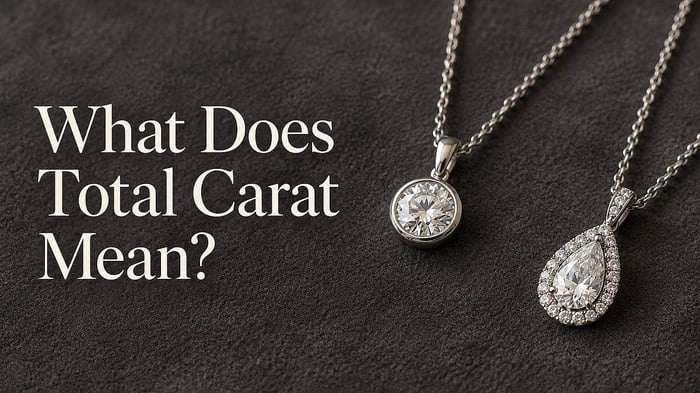
The listing describes one round 1.00ct lab-grown diamond in a 9k white-gold bezel setting. Here the diamond total and the weight of the single stone refer to the same thing. It is a useful comparison point for designs that spread an equal total across a centre stone and smaller surrounding diamonds.
That still does not make carat weight a complete description of appearance. Shape and measurements tell you about the stone’s outline, while the setting contributes to the finished jewellery. The useful response is not to discard the weight but to give it the right job: describing how much the diamond weighs.
This distinction also prevents an easy mistake with elaborate “solitaire-style” designs. A dominant centre stone does not prove that the jewellery contains no other diamonds. Read the specification rather than deciding from the visual emphasis alone.
Compare The Information Behind The Design
Browse diamond jewellery with the stone arrangement in mind. A useful shortlist includes what the weight covers, not only the number itself.
Read A Halo In Two Parts
With a halo, separate the centre diamond from the surrounding stones. A combined total tells you how much diamond is present, but not how much of that weight sits in the focal stone. Both numbers can matter, and they answer different questions.

One Carat Across The Design
Lab Diamond Pear Halo Pendant Necklace 1.00ct D/VVS in 9k White Gold
This pendant is listed as 1.00ct in total, with a 0.75ct centre diamond. Subtracting the stated centre weight leaves 0.25ct for the other diamonds combined. That is not the weight of each halo stone. The 9k white-gold design illustrates how an identical headline total can describe a different arrangement from the solitaire.
The arithmetic is straightforward. In that example, 1.00ct total minus a stated 0.75ct centre leaves 0.25ct across the remaining diamonds. It does not tell you the number of halo stones or their individual weights. Those are separate details, not facts you can recover by looking harder at the total.
Nor is the halo somehow a lesser version of the solitaire. It is a different design. The point is to compare it as the design it is, rather than assuming both pendants contain a one-carat centre stone. An informed preference for the halo needs no apology.
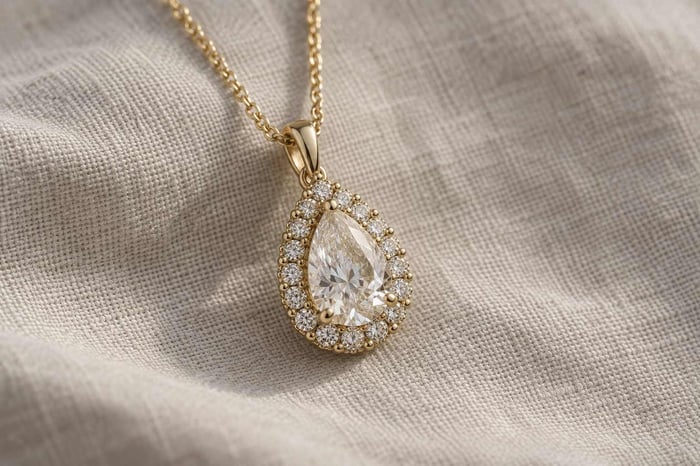 A halo has a centre diamond and surrounding stones. Their combined weight does not describe the centre alone.
The same reading habit applies to diamond-set shoulders, three-stone rings and cluster designs. Establish the combined weight, then look for the weight of the stone or stones that matter most to your decision. Where the breakdown is not supplied, ask rather than inventing it.
With Earrings, Check Whether The Total Means The Pair
A pair of earrings creates an extra opportunity for confusion: the sales unit has two parts. A total for the pair is not a promise of that weight on each ear. Look for explicit wording such as “per earring”, “each diamond” or “combined weight”.

The Pair Is The Unit
Lab Diamond Stud Earrings 0.50ct G/VS in 9k Yellow Gold
The product description specifies a 0.25ct diamond in each earring: 0.50ct across the pair. These round studs are set in 9k yellow gold. They demonstrate why the words “each” and “pair” matter as much as the carat number when comparing earrings.
For a hypothetical pair of matched solitaire studs totalling 1.00ct, an even division would be about 0.50ct per earring. That is a calculation based on the assumed equal split, not independent proof of either stone’s precise weight. The actual specification should settle the detail.
Halo and cluster earrings require another step. Even after dividing the pair’s total, you may still be looking at several diamonds in each earring. Dividing a one-carat halo pair by two does not establish a half-carat centre diamond on each side.
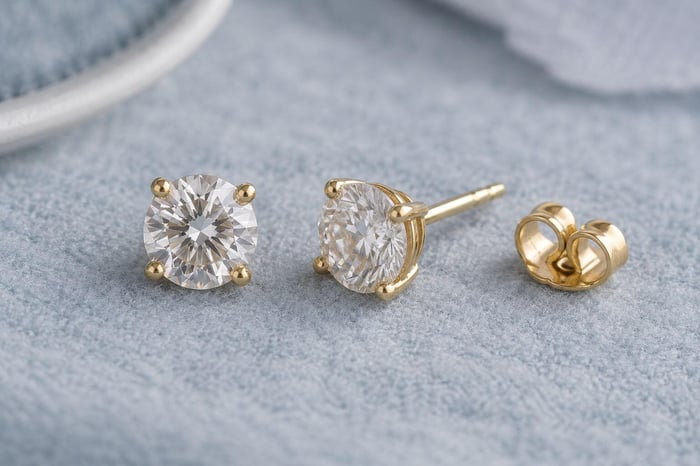 For earrings, establish whether the quoted weight covers the pair, one earring or an individual stone.
Once the unit is clear, use the stud earring size guide to consider dimensions and how the earrings will sit. That is a different decision from identifying the quantity described by the listing, and it is better made with the correct starting information.
Do Not Ask A Total To Tell You About Every Stone
A bracelet can distribute its diamonds along a line. A ring can concentrate them into a cluster. Even where two designs have the same total, they may use different numbers of stones and different size distributions. Adding the weights does not preserve those details.
Dividing a total by the stone count produces an average, not a description of every diamond. In an illustrative ten-stone piece totalling 1.00ct, the average is 0.10ct. You could only call every stone 0.10ct if their individual weights or a properly specified uniform arrangement supported that statement. A graduated design makes the limitation especially obvious.
The total also says nothing by itself about colour, clarity, cutting quality or how carefully the stones have been matched. These belong elsewhere in the specification. A larger sum is not a substitute for that information, and equal sums do not make two finished pieces equivalent purchases.
Keep grading information separate from the scope of a report. If a product includes an individual diamond report, check which stone it identifies. Do not assume that the document covers every accent diamond too. Equally, the absence of separate reports for small stones does not establish that they were ungraded or carelessly selected: an individual report and the jeweller’s specification or selection are different things.
GIA’s account of designing with small diamonds, known as melee describes the importance of these stones within a complete design. Their contribution is not measured by whether each arrives with its own piece of paper.
Use A Simple Listing Check Before You Compare
Before comparing two pieces, write down three things in plain language: what is being sold, what the stated diamond total includes and how that weight is distributed. “One pendant, one diamond, one carat” is a much better starting point than a copied headline number.
Then add the details that matter to the finished piece: its selected metal, dimensions, setting and the applicable diamond-quality description. Record any specific centre-stone weight or per-earring weight separately. There is no need to gather every possible measurement, only the information your comparison actually depends on.
When a title, description and specification do not agree, stop treating the numbers as interchangeable. Ask the seller to confirm the current specification for the exact item in writing. A plausible explanation or a familiar product photograph is not a resolution of contradictory wording.
The aim is not to find the biggest total and declare a winner. It is to understand where the diamonds are, what the stated weight means and whether that design gives you what you wanted. Once those questions are answered, the number becomes useful rather than distracting.
Choose The Arrangement You Actually Want
Compare a concentrated solitaire with the balance of a pair of studs. Read each selected product’s weight description alongside its design and dimensions.
Frequently Asked Questions
Does Total Carat Weight Mean The Centre Diamond’s Weight?
Only when the total genuinely refers to that single diamond. In a halo, cluster or diamond-set band, the total may include several stones. Look for a separate centre-stone weight.
Are One-Carat Earrings One Carat Each?
Not automatically. The number may describe the pair. Check whether the listing says combined weight, per earring or per stone, especially where each earring contains more than one diamond.
Can I Divide Total Weight By The Number Of Diamonds?
You can calculate an average. You cannot assume that every diamond has that weight unless the specification supports an equal distribution. Graduated pieces are an obvious case where the average differs from individual stone weights.
Does Total Carat Weight Tell Me How Big The Jewellery Will Look?
Not on its own. It describes a weight total, not the finished dimensions or the arrangement of the stones. Compare the relevant measurements, setting and design as well.
Should Every Small Diamond Have An Individual Grading Report?
Do not assume that separate reports accompany every small diamond. Check the product’s quality specification and the scope of any report supplied. Missing individual reports do not by themselves establish an absence of grading or careful selection.