
Quick Answer
When buying diamond stud earrings, check the carat total weight, usually written as CTW. This is the combined diamond weight of both earrings. A 1.00 CTW pair usually means two 0.50 carat diamonds, one in each ear. For everyday wear, many buyers prefer 0.50 CTW to 1.00 CTW. For a more noticeable look, 1.50 CTW to 2.00 CTW gives stronger visual presence.
Diamond stud earrings seem simple until you start comparing sizes. One pair looks delicate. Another looks classic. Another looks much larger than expected. Then the descriptions start using carat, CTW and millimetres, and it is not always obvious what you are actually buying.
The most important thing to understand is carat total weight, often shortened to CTW. For stud earrings, CTW refers to the total diamond weight across the pair, not the weight of each individual earring. This is where many first-time buyers get caught out.
A 1.00 CTW pair does not usually mean each earring contains a 1.00 carat diamond. It means the pair contains approximately 1.00 carat in total, so each stud is usually around 0.50 carat.
That one distinction makes diamond stud earrings much easier to compare. Once you understand CTW, you can look at millimetre size, visual impact, comfort and shape with far more confidence.
If you have already read our guide to diamond size, the same principle applies here: carat tells you weight, but it does not tell the whole visual story.
Watch: CTW Explained For Diamond Stud Earrings
A short guide to CTW, millimetre size and how different diamond stud sizes look when worn.
In This Article
- What CTW Means For Diamond Stud Earrings
- Carat Weight And Millimetre Size Are Not The Same Thing
- Choosing The Right Stud Size For Everyday Wear
- The Classic Sweet Spot: 1.00 CTW
- When To Choose Larger Diamond Studs
- How Diamond Shape Changes Visual Size
- Stud Size By Wearing Style
- Do Lab-Grown Diamond Studs Change The Size Decision?
- A Simple Way To Decide
- Browse Diamond Stud Earrings With Confidence
- FAQ
What CTW Means For Diamond Stud Earrings
CTW stands for carat total weight. In a pair of diamond studs, it describes the combined diamond weight of both earrings.
In practice:
- 0.50 CTW usually means two 0.25 carat diamonds
- 1.00 CTW usually means two 0.50 carat diamonds
- 2.00 CTW usually means two 1.00 carat diamonds
This matters because product descriptions often lead with the total pair weight. That is normal in jewellery retail, but it can be confusing if you are expecting the number to apply to each ear.
The simple way to think about it is this: for a matched pair of diamond studs, divide the CTW by two to understand the approximate carat weight of each diamond.
So, if a pair is listed as 1.50 CTW, each stud is usually around 0.75 carat. If a pair is listed as 0.25 CTW, each stud is usually around 0.125 carat.
There can be small variation between individual stones, especially with matched pairs, but this rule gives you a reliable starting point.
Lab Diamond Stud Earrings 0.20ct G/VS in 925 Silver

£152.00
£305.00
Embrace timeless elegance with the chic Lab Diamond Stud Earrings featuring sophisticated solitaire stones. The earrings showcase a total of 0.20ct of lab-grown diamonds, claw-set to highlight its brilliance and round shape. Crafted in lustrous 925 silver, these earrings are… read more
Carat Weight And Millimetre Size Are Not The Same Thing
Carat is a measure of weight. Millimetres measure physical diameter or face-up size. Buyers often use carat because it is the familiar jewellery term, but millimetre size is what your eye actually sees when the stud is worn.
For round brilliant cut diamonds, the relationship between carat and millimetre size is fairly consistent. A well-cut round diamond of a given weight will usually sit within a familiar diameter range.
That makes round brilliant studs easier to compare than some other shapes. They are balanced, symmetrical and predictable on the ear.
Here is a practical guide for standard round brilliant diamond studs:
0.10 CTW
Approx. 0.05 ct per ear
Approx. 2.4 mm per diamond
Very delicate shimmer, often suited to cartilage piercings or very subtle extra sparkle.
0.25 CTW
Approx. 0.125 ct per ear
Approx. 3.2 mm per diamond
Dainty and subtle, especially useful for second or third lobe piercings.
0.50 CTW
Approx. 0.25 ct per ear
Approx. 4.1 mm per diamond
A light everyday size with clean sparkle, good for minimalist wear.
1.00 CTW
Approx. 0.50 ct per ear
Approx. 5.1 mm per diamond
The classic staple size, visible without feeling too large for most wearers.
1.50 CTW
Approx. 0.75 ct per ear
Approx. 5.8 mm per diamond
Noticeable and polished, with stronger presence as a main earring.
2.00 CTW
Approx. 1.00 ct per ear
Approx. 6.5 mm per diamond
Bold and luxurious, often best as the main earring or for a stronger statement.
These measurements are approximate. Cut quality, setting style and the exact proportions of the diamond can all influence the look. Still, the table gives a useful scale for first-time buyers.
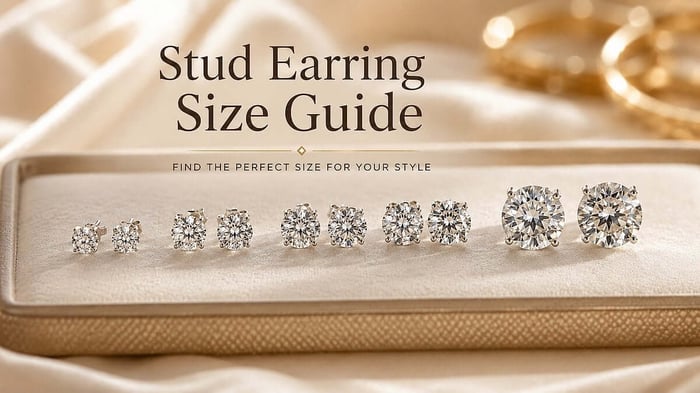
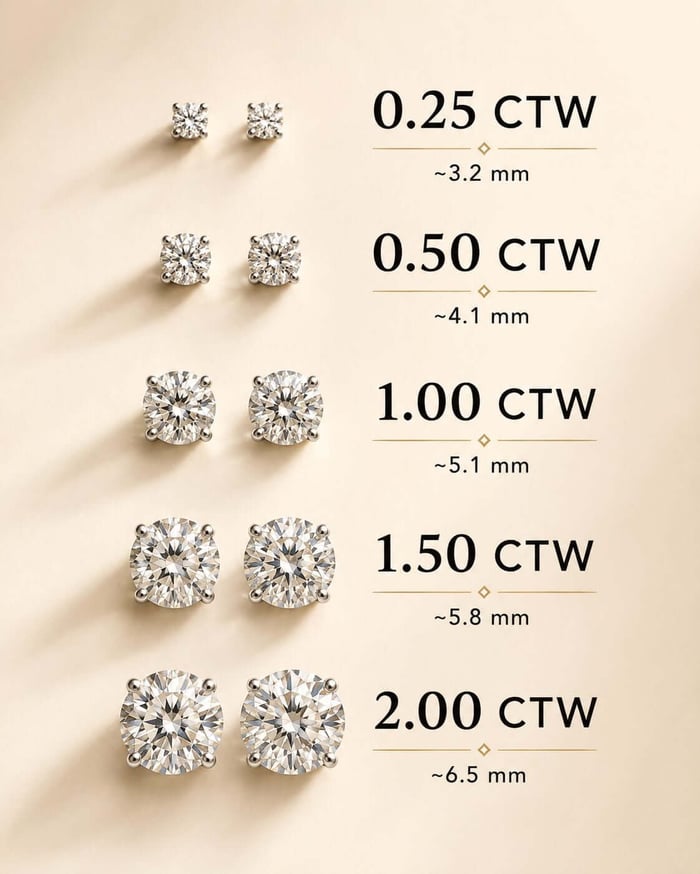 A simple visual comparison of common diamond stud earring sizes, from subtle everyday studs to a more noticeable 2.00 CTW pair.
Choosing The Right Stud Size For Everyday Wear
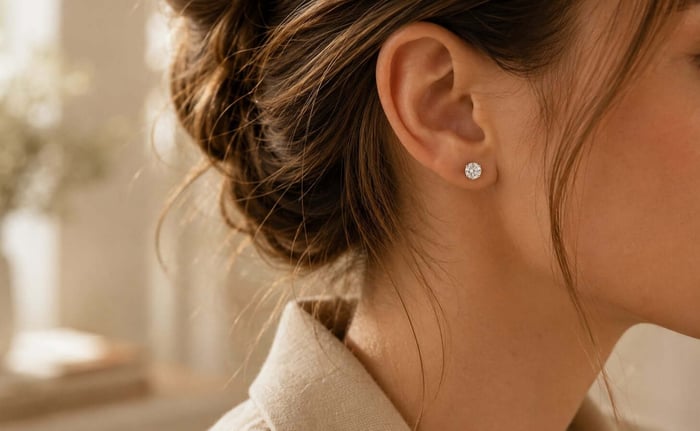
For everyday wear, most buyers are looking for a balance of visibility, comfort and versatility. The right size should look intentional without feeling awkward, heavy or too formal for normal use.
For many people, 0.50 CTW to 1.00 CTW is the most practical everyday range.
A 0.50 CTW pair is usually subtle and easy to wear. Each diamond is around 0.25 carat, so the earrings give a clean sparkle without drawing too much attention. This size works particularly well if you prefer minimal jewellery or want something comfortable enough for regular use.
A 1.00 CTW pair is the classic step up. Each diamond is around 0.50 carat, giving a more visible sparkle from a normal conversational distance. It is often the size people have in mind when they picture a traditional pair of diamond studs.
If you want studs for second piercings, third piercings or a stacked ear look, smaller sizes usually work better. A pair between 0.25 CTW and 0.50 CTW can give sparkle without overcrowding the ear.
For a first pair, the safest question is not “what is the biggest size I can afford?” It is “what size will I actually enjoy wearing often?”
That is why our guide to your first real jewellery collection is relevant here. The most useful jewellery pieces are often the ones that fit naturally into real life.
Choosing Your First Pair?
If you are comparing sizes, start with the pair you would wear most often rather than the largest size on the page. Browse our lab-grown diamond earrings. Use the filters to narrow by shape, setting and metal colour.
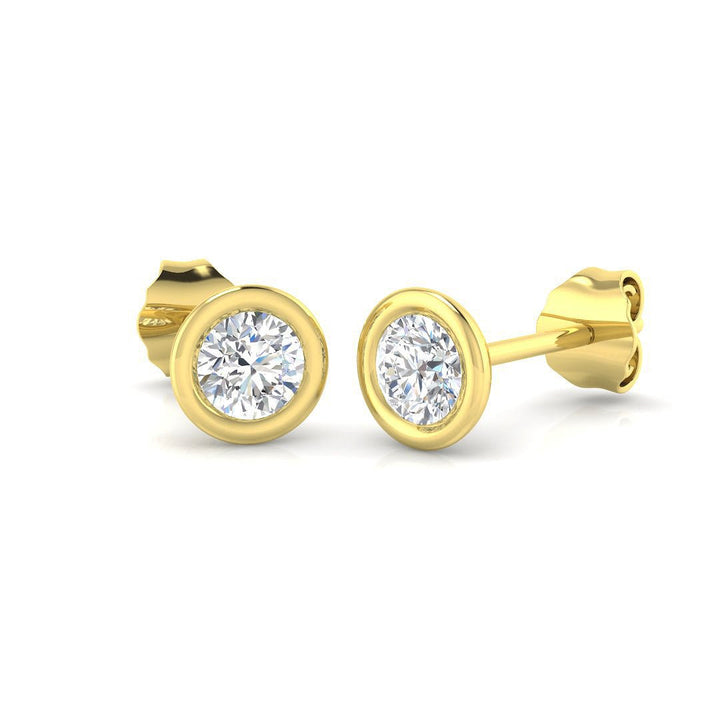
Lab Diamond Solitaire Stud Bezel Set Earrings 1.00ct G/VS 18k Yellow Gold
£885.00
£1,390.00
Exude elegance with our Lab Diamond Solitaire Stud Bezel Set Earrings, adorned with a stunning 1.00 carat total weight of G/VS-graded lab-grown diamonds. These earrings showcase a solitaire diamond in a bezel setting, adding a touch of sophistication to your… read more
The Classic Sweet Spot: 1.00 CTW
A 1.00 CTW pair is widely treated as the classic diamond stud size. It offers enough presence to feel special, but it is not so large that it automatically becomes occasion-only jewellery.
Because each stud is usually around 0.50 carat, the face-up size is visible but still restrained. On many ears, it covers a modest part of the lobe and gives the clean, balanced look people expect from diamond studs.
It is also a popular gift size because it feels significant without requiring the buyer to make an extreme style decision. Smaller studs may be perfect for a minimalist wearer, while larger studs may be better for someone who already enjoys bolder jewellery. A 1.00 CTW pair sits comfortably in the middle.
There are still personal factors to consider. Smaller earlobes may make a 1.00 CTW pair look more prominent. Larger earlobes may make the same pair look more understated. Hair length, usual clothing style and whether the studs will be worn alone or with other earrings can also change the overall impression.
Put simply, 1.00 CTW is a strong default, not a universal rule.
When To Choose Larger Diamond Studs
A pair between 1.50 CTW and 2.00 CTW gives a much more noticeable look. This range works well if the studs are intended as a primary earring, a special gift or a piece that should feel more dressed-up.
At 1.50 CTW, each diamond is usually around 0.75 carat. That gives a clear increase in visual impact compared with 1.00 CTW, but it can still feel wearable if the setting is well balanced.
At 2.00 CTW, each diamond is usually around 1.00 carat. This is a bolder look. The earrings will be much more visible and may feel more like standalone jewellery than a quiet everyday staple.
The practical issue with larger studs is not only size. It is also weight and balance. Larger diamonds can pull forward on the ear, especially if the post and backing are not secure enough. This is why backing choice becomes more important as the studs get larger.
For bigger studs, consider:
- Sturdy butterfly backs
- Larger clutch backs
- Secure lock backs or la pousette backs
- Settings designed to sit neatly against the lobe
If a stud droops forward, it can make even a beautiful diamond look less balanced. The right back helps the diamond face forward properly, which improves both comfort and appearance.
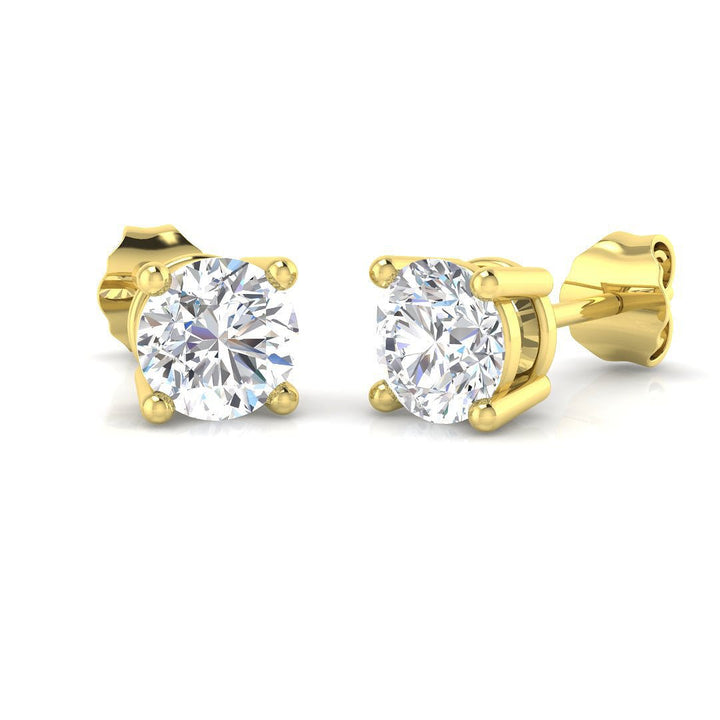
Lab Diamond Solitaire Stud Earrings 3.00ct D/VVS in 18k Yellow Gold
£1,645.00
£2,850.00
Make a statement with the elegant Lab Diamond Solitaire Stud Earrings, designed and handcrafted in the UK with the finest materials. These earrings feature 3.00 carats of D/VVS-graded lab-grown diamonds, set in 18k yellow gold claw settings. The round solitaire… read more
How Diamond Shape Changes Visual Size
The size table above is most useful for round brilliant diamonds. Other diamond shapes can look larger or smaller than a round diamond of the same carat weight because they distribute weight differently.
Elongated shapes usually look larger from the top because they spread across more surface area. These include:
- Oval
- Pear
- Marquise
- Emerald cut, depending on proportions
A 0.50 carat oval, for example, can look longer and more prominent than a 0.50 carat round diamond. This does not mean it contains more diamond. It means more of the weight is arranged in a way that the eye reads as length and coverage.
Deeper or more compact shapes can sometimes look slightly smaller face-up. Princess and Asscher cuts, for example, may hold more weight in depth. They can still be beautiful choices, but the visible spread may feel different from a round brilliant of the same carat.
This is why shape matters when judging size. Carat tells you the weight. Millimetres tell you more about what you will see. Shape influences how that size feels on the ear.
For more on this, our article on diamond shapes and personal fit is a useful companion.
Lab Diamond Pear Halo Earrings 1.00ct D/VVS in 9k Yellow Gold

£625.00
£1,195.00
Elevate your style with these exquisite Lab Diamond Pear Halo Earrings, featuring a dazzling 1.00ct total weight in D/VVS quality diamonds. Each earring centres on a lustrous pear-shaped lab diamond, exquisitely framed by round side stones in a classic claw… read more
Stud Size By Wearing Style
The best stud size depends partly on how you plan to wear the earrings.
For second or third piercings
Choose smaller studs, usually around 0.10 CTW to 0.25 CTW. These add light without competing with your main earrings.
For minimalist everyday wear
Look around 0.50 CTW. This gives a clean sparkle while staying subtle, comfortable and easy to style.
For a classic first pair
Start around 1.00 CTW. This is the balanced size many buyers expect when they want a proper pair of diamond studs.
For a more polished look
Consider 1.50 CTW. This gives a clear step up in presence without always feeling too bold.
For a statement pair
Look at 2.00 CTW and above. At this point, backing quality and lobe support become especially important.
It can also help to think about your usual jewellery habits. If you wear diamond pendants, tennis bracelets or rings regularly, larger studs may feel natural. If you normally wear small hoops or simple studs, a moderate size may be more useful.
Do Lab-Grown Diamond Studs Change The Size Decision?
Lab-grown diamonds can make larger or higher-quality diamond studs more accessible than equivalent mined diamond options. That does not mean you should automatically buy the largest pair available.
The better advantage is choice. You may be able to compare a larger CTW, a higher colour grade, a better clarity grade or a preferred setting style within the same broad budget.
For stud earrings, this can be especially helpful because earrings are usually seen at a conversational distance. You do not need to chase perfection in every specification, but you do want a pair that looks bright, balanced and well matched.
For many buyers, the sensible route is to choose the size first, then use lab-grown diamond value to improve the overall quality of the pair. That might mean a cleaner colour, a more attractive setting or a more secure backing.
Our guide to buying your first lab diamond stud earrings goes deeper into that first-pair decision.
A Simple Way To Decide
If you are stuck between sizes, use this simple approach.
First, decide where the studs will sit. Main lobe earrings can usually be larger than second or third piercing studs.
Second, decide whether you want subtle, classic or statement. Subtle usually sits around 0.25 CTW to 0.50 CTW. Classic is often around 1.00 CTW. Statement usually starts around 1.50 CTW.
Third, check the per-ear size. Divide the CTW by two, then look at the approximate millimetre diameter.
Finally, think about comfort. If the pair is larger, the backing matters more. A secure, supportive back can make the difference between studs that sit properly and studs that lean forward.
The right pair should feel clear once you understand the numbers. CTW tells you the total. Per-ear carat tells you what each stud contains. Millimetres tell you what the eye sees. Shape and setting then refine the final impression.
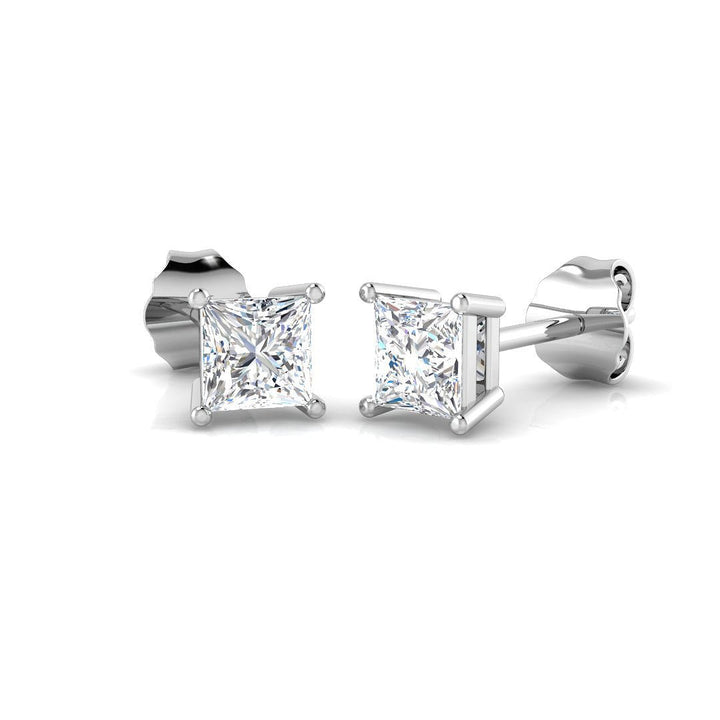
Lab Diamond Princess Stud Earrings 4.00ct D/VVS in 18k White Gold
£2,105.00
£3,690.00
Elevate your style with these exquisite Lab Diamond Princess Stud Earrings, featuring a total of 4.00 carats of beautiful D/VVS-graded lab-grown diamonds in a claw setting. The princess-cut diamonds are set in luxurious 18k white gold and are handcrafted in… read more
Browse Diamond Stud Earrings With Confidence
Diamond studs are easy to love because they work with almost everything. The key is choosing a size that fits your ear, your routine and your sense of style.
Browse our lab-grown diamond earring collection to compare sizes, shapes and settings, or use this guide as a reference point while narrowing your shortlist. A well-chosen pair should not feel like a guess. It should feel considered, wearable and reassuringly right.
Find The Pair That Fits Your Everyday Style
Compare lab-grown diamond stud earrings by size, shape and setting, then choose the pair that feels right for real wear, not just for a specification sheet.
FAQ
What does CTW mean for diamond stud earrings?
CTW means carat total weight. For diamond stud earrings, it usually refers to the combined diamond weight of both earrings, not the weight of each individual stud.
Is 1.00 CTW the same as one carat per earring?
No. A 1.00 CTW pair usually means the pair totals one carat, so each earring is usually around 0.50 carat.
What is a good everyday size for diamond studs?
For many buyers, 0.50 CTW to 1.00 CTW is a practical everyday range. Smaller sizes are more subtle, while 1.00 CTW gives a classic visible sparkle.
What size diamond studs are best for second piercings?
Second or third piercings usually suit smaller studs, often around 0.10 CTW to 0.25 CTW, depending on the look you want.
Do oval or pear diamond studs look larger than round studs?
They can. Elongated shapes such as oval, pear and marquise often look larger from the top than round diamonds of the same carat weight because their weight is spread over more length.
Do larger diamond studs need different backs?
Often, yes. Larger studs can lean forward if the backing is not supportive. Wider clutch backs, secure lock backs or la pousette backs can help the diamonds sit better on the ear.