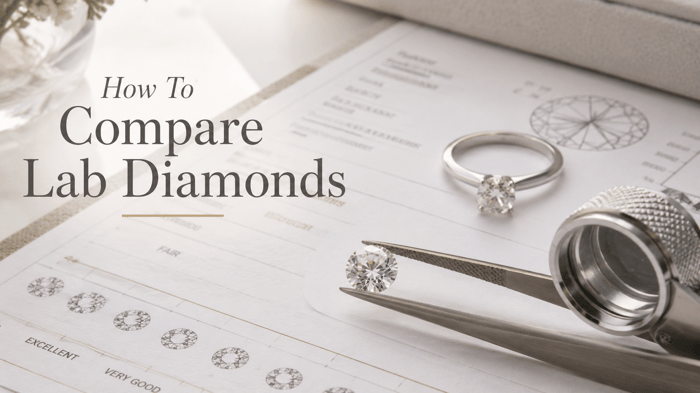

Comparing lab diamonds sounds as if it should be simple. Look at the carat weight, check the colour and clarity, compare the price, then choose the best one.
In practice, it is not quite that tidy.
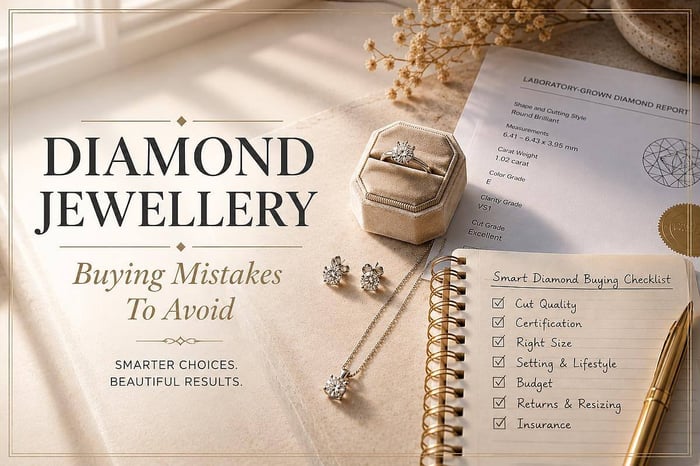
A diamond report is an important buying tool, but it is not a magic answer sheet. It tells you a great deal about a diamond, but it does not remove the need for judgement. Different grading laboratories may now use fundamentally different reporting systems. Smaller stones are often not individually certified at all. Two diamonds with the same headline appeal can still look different when set into a ring, pendant or pair of earrings.
The aim is not to become a gemmologist before you buy. The aim is to know what actually matters.
Quick Answer
To compare lab diamonds properly, look beyond carat weight. Start with certification where available, then compare the grading lab, cut, colour, clarity, carat weight, shape, measurements and price together. For certified lab-grown diamond collections, After Diamonds uses IGI reports. Smaller accent stones are often not individually certified because the cost of grading would usually be disproportionate to the value of each small stone.
A short guide to comparing lab-grown diamonds by certification, cut, colour, clarity, carat weight and real-world value.
Contents
- Why Lab Diamond Comparison Can Feel Confusing
- What A Lab Diamond Certificate Actually Tells You
- Why GIA And IGI Lab Diamond Reports Now Feel Very Different
- Why Smaller Diamonds Are Often Not Individually Certified
- The Main Factors To Compare
- A Practical Comparison Method
- Certification Is Useful, But Not Perfect
- Common Mistakes When Comparing Lab Diamonds
- How After Diamonds Buyers Should Think About Value
- Before You Choose, Compare With Confidence
- FAQ
Why Lab Diamond Comparison Can Feel Confusing
Lab-grown diamonds are real diamonds. They have the same basic chemical composition and optical properties as mined diamonds. That is why ordinary visual inspection is not enough to identify origin with certainty.
The difficulty for buyers is that diamond comparison is both technical and commercial. You are not only asking “is this a diamond?” You are also asking:
- how good is it?
- who graded it?
- how detailed is that grading?
- does the certificate describe the stone clearly?
- does the stone look good in the jewellery?
- is the price sensible for the quality?
That is why certification matters. But it also explains why certification should be used as guidance rather than treated as the whole decision.
What A Lab Diamond Certificate Actually Tells You
A lab diamond report usually records the stone’s key characteristics. These may include carat weight, colour, clarity, cut, polish, symmetry, measurements, shape and sometimes growth method or post-growth treatment information.
For After Diamonds’ certified lab-grown diamond collections, IGI certification is used. You can read more about the IGI Laboratory Grown Diamond Report directly from IGI.
This matters because a certificate gives the buyer a shared reference point. Without it, one jeweller’s description may not be easy to compare with another’s.
A certificate helps answer questions such as:
- what is the stated colour grade?
- what is the stated clarity grade?
- how large is the stone in millimetres?
- how has it been cut?
- does the report number match the diamond?
- is the diamond described as laboratory grown?
That is useful. But it is not the same as saying every certificate tells the entire visual story.
Considering A Certified Lab Diamond?
A good report should help you compare, not confuse you. After Diamonds uses IGI reports for certified lab-grown diamond collections, helping buyers understand the key quality details before choosing.
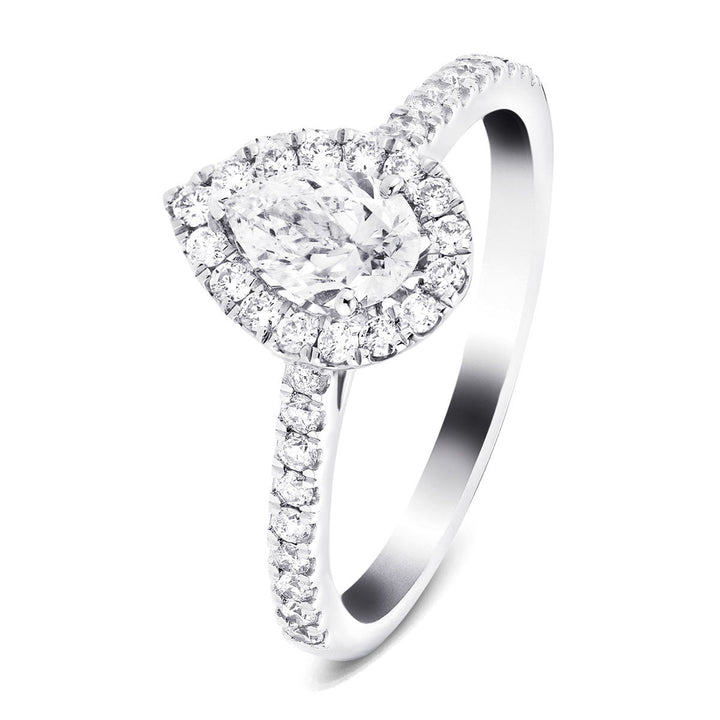
Nancy Lab Diamond Halo Pear Engagement Ring 0.85ct D/VVS in 9k White Gold
£905.00
£1,496.00
Experience the joy of love with the Nancy Lab Diamond Halo Pear Engagement Ring, designed to embody the purity of your affection. This ring features a stunning 0.85-carat total weight of diamonds, including a pear-cut, D/VVS grade diamond with a… read more
Why GIA And IGI Lab Diamond Reports Now Feel Very Different
One reason buyers become confused when comparing lab diamonds is that GIA and IGI now approach laboratory-grown diamond reporting in fundamentally different ways.
This is not simply a question of one lab using slightly different wording from another. The two systems now serve different purposes.
GIA: A Broader Quality Assessment
GIA has moved away from using the traditional highly granular natural-diamond grading style for many laboratory-grown diamonds. Instead of focusing on precise combinations such as E colour and VS1 clarity, GIA now uses a broader Laboratory-Grown Diamond Quality Assessment framework for qualifying stones.
This framework classifies qualifying lab-grown diamonds into broad categories such as Premium and Standard.
The reasoning is practical. Many modern lab-grown diamonds are manufactured within a relatively narrow high-quality range, so GIA concluded that ultra-fine distinctions were becoming less meaningful for much of this manufactured category.
IGI: A More Granular 4Cs-Style Report
IGI has taken a different route. For lab-grown diamonds, IGI largely continues to use the familiar detailed grading language buyers already recognise from natural diamond reports.
That usually means precise colour grades, clarity grades, measurements, proportions, polish, symmetry and related specification details.
For many retail buyers, this makes IGI reports easier to use when comparing two diamonds side by side for value, proportions and visible characteristics.
The important point is not that one laboratory is “right” and the other is “wrong”. They are now describing lab-grown diamonds through different reporting philosophies.
A GIA “Standard” assessment and an IGI report showing, for example, E colour and VS1 clarity are not always easy to compare directly. The certificate remains extremely useful, but buyers should understand the language of the report before treating it as a like-for-like comparison.
This is also why IGI has become especially visible in the lab-grown diamond jewellery market. Its reports give consumers the granular data many already expect when comparing diamonds.
Why Smaller Diamonds Are Often Not Individually Certified
This is one of the most common points of confusion.
A ring may contain a certified centre stone but smaller side stones or accent stones that are not individually certified. A pair of earrings, bracelet or pendant may also include smaller diamonds that are described by quality range rather than accompanied by individual reports.
That is normal.
The reason is commercial common sense. Certifying every tiny diamond would add unnecessary cost. In many cases, the grading cost could be disproportionate to the value of the individual stone. That extra cost would eventually be passed to the buyer without adding much practical benefit.
For smaller stones, reputable jewellers usually rely on sourcing standards, supplier controls, jewellery-level quality checks and stated quality ranges. For larger centre stones, certification becomes more useful because the stone represents a greater proportion of the item’s value.
Put simply, certification is most valuable where the individual diamond is significant enough to justify the additional cost and documentation.
The Main Factors To Compare
A certificate gives you data. Your job is to understand which data matters most.
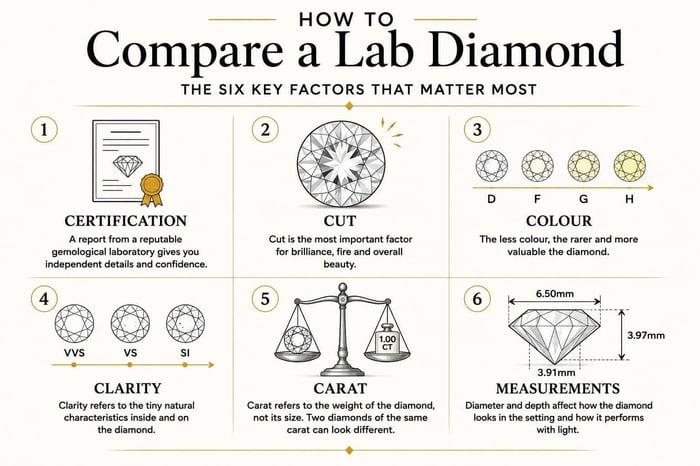
1. Cut
Cut has a major effect on sparkle, especially in round brilliant diamonds. A well-cut diamond can look lively and bright. A poorly cut diamond may look flat even if the colour and clarity grades seem attractive.
For most buyers, cut should be near the top of the comparison list.
2. Colour
Colour describes how colourless or tinted a diamond appears. In many lab diamond purchases, buyers look for higher colour grades because lab-grown diamonds can make better colour more accessible.
That does not mean every buyer needs the very highest colour grade. The setting metal, diamond size and personal preference all matter. A near-colourless diamond can look excellent in many pieces of jewellery.
3. Clarity
Clarity describes internal and surface characteristics visible under 10x magnification.
Many buyers over-focus on clarity. The practical question is not only what the grade says, but whether the diamond looks clean to the eye in normal wear. A high clarity grade can be reassuring, but it is not always where the best value lies.
4. Carat Weight
Carat weight measures weight, not visible size. Two diamonds of the same carat weight can have different measurements, especially if one carries more weight in the depth rather than across the top.
Always compare the millimetre measurements as well as the carat weight.
5. Shape
Shape affects both appearance and value. Round brilliants are popular because of their sparkle, while ovals, cushions, emerald cuts, pears and radiant cuts each behave differently.
Fancy shapes can offer strong visual presence, but they also need more careful judgement. Length-to-width ratio, symmetry and bow-tie effect may matter more than the certificate headline suggests.
6. Price
Price should be compared only after quality has been understood. The cheapest stone is not automatically the best value. Nor is the most expensive stone automatically the best choice.
A better question is: does the price make sense for the certification, size, cut, colour, clarity, shape and setting?
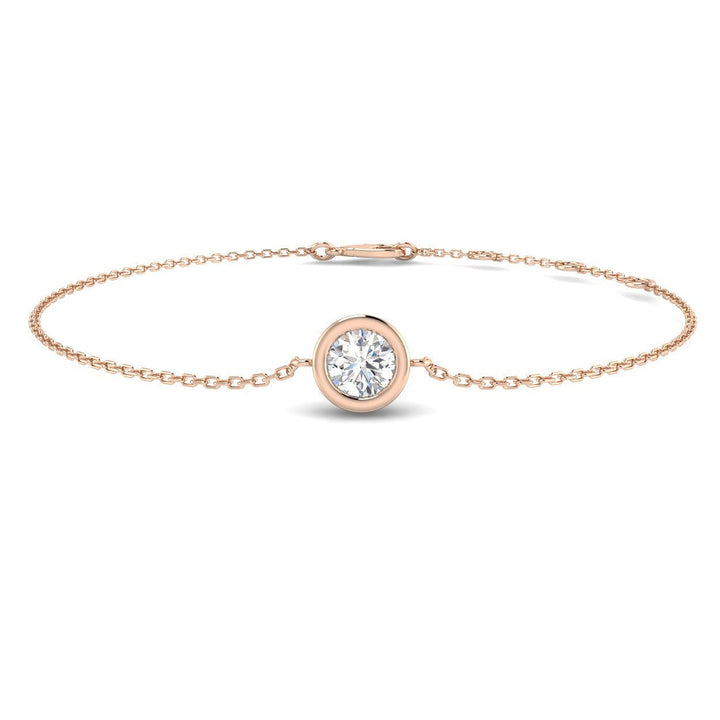
Lab Solitaire Diamond Bracelet 1.00ct D/VVS Quality in 9k Rose Gold
£1,355.00
£2,306.00
Elevate your style with the stunning Lab Solitaire Diamond Bracelet, featuring a 1.00-carat D/VVS-quality bezel-set solitaire diamond in 9k rose gold. The diamond is IGI certified, and the gold is UK hallmarked. A lifetime workmanship guarantee backs the workmanship of… read more
A Practical Comparison Method
When comparing two lab diamonds, use this order:
- Check whether both stones are certified.
- Compare the grading laboratory.
- Understand whether the report is granular or category-based.
- Compare carat weight and measurements together.
- Compare cut, polish and symmetry where those details are provided.
- Compare colour and clarity where those grades are provided.
- Look at the shape and proportions.
- Consider how the stone will appear in the finished jewellery.
- Compare price last.
This prevents a common mistake: choosing the larger or cheaper stone before understanding why it is larger or cheaper.
Certification Is Useful, But Not Perfect
Buyers sometimes think a certificate turns diamond buying into an objective calculation. It does not.
A diamond report is a professional assessment. It is extremely useful, but it still operates within grading rules, laboratory methodology and descriptive limits.
Even testing technology has limits. Professional screening devices can help identify whether diamonds are natural, laboratory grown or require further testing, but they do not remove the role of gemmological laboratory analysis. GIA itself explains that laboratory-grown diamonds need advanced testing to identify origin reliably.
That is the important industry reality. Certification reduces uncertainty. It does not eliminate judgement.
Common Mistakes When Comparing Lab Diamonds
The first mistake is comparing carat weight alone. A larger diamond with weaker cut or awkward proportions may not be the better choice.
The second mistake is assuming that every certificate is directly interchangeable. GIA and IGI now use notably different reporting approaches for laboratory-grown diamonds.
The third mistake is expecting every diamond in a piece of jewellery to have its own individual report. For small accent stones, this is usually unnecessary and commercially inefficient.
The fourth mistake is overpaying for a grade the eye will never appreciate. A very high clarity grade may sound impressive, but if a lower clarity diamond is still eye-clean, the extra spend may not improve the way the jewellery looks.
The fifth mistake is ignoring the finished piece. A diamond is not worn as a spreadsheet. It is worn in a ring, pendant, bracelet or pair of earrings. The setting, metal colour, design and craftsmanship all affect the final impression.
How After Diamonds Buyers Should Think About Value
For most buyers, value comes from the balance of quality, beauty, certification and price.
If a diamond is certified, use the report. If smaller stones are not individually certified, understand why. If two stones look similar on paper, compare the measurements, cut and setting context. If two labs use different reporting approaches, do not pretend the comparison is perfectly simple.
For more background on the wider buying framework, our guide to choosing beyond the 4Cs explains why practical judgement matters alongside formal grading.
The best purchase is not always the highest grade. It is the diamond that gives you the right balance of confidence, appearance and price.
Before You Choose, Compare With Confidence
After Diamonds focuses on lab-grown diamond jewellery for buyers who want beauty, clarity and sensible value. For certified lab-grown diamond collections, IGI reports provide an important reference point, while our wider jewellery standards help ensure that each piece feels considered as a finished item.
If you are comparing diamonds for an engagement ring, pendant, earrings or another important piece, start with the facts, then look at the whole design. The right diamond should make sense on paper and feel right in the jewellery.
Choose A Lab Diamond With Clarity
Explore After Diamonds lab-grown diamond jewellery with a clearer understanding of certification, grading detail, proportions and real-world value. A good choice should feel reassuring before you buy and beautiful every time it is worn.
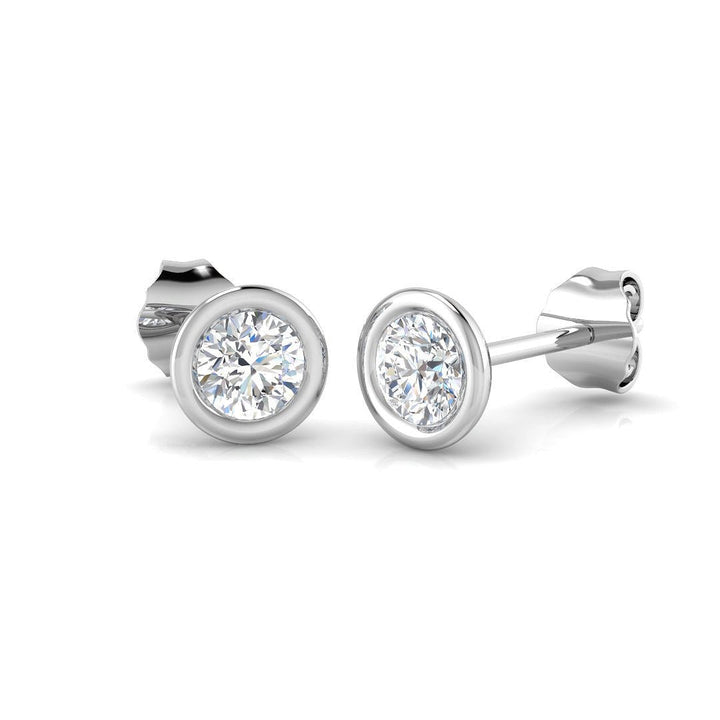
Lab Diamond Solitaire Stud Bezel Set Earrings 1.00ct G/VS 18k White Gold
£885.00
£1,390.00
Elevate your style with our Lab Diamond Solitaire Stud Bezel Set Earrings, crafted by hand from 18k white gold in the UK. Each earring set features a stunning 1.00 carats of G/VS-graded lab-grown diamond in a bezel setting, creating a… read more
FAQ
Are IGI Certified Lab Diamonds Good?
Yes. IGI is widely used for lab-grown diamond certification and has a strong presence in the lab diamond market. As with any grading report, it should be read carefully and understood in context.
Is GIA Better Than IGI For Lab Diamonds?
Not necessarily. GIA and IGI now use different reporting approaches for lab-grown diamonds. GIA uses a broader quality assessment for qualifying stones, while IGI provides more granular 4Cs-style report detail.
Why Are Smaller Diamonds Not Individually Certified?
Small accent diamonds are often not individually certified because the cost of grading them would usually be disproportionate to their value. Reputable jewellers instead rely on sourcing standards, stated quality ranges and jewellery-level quality control.
Can A Diamond Tester Prove A Lab Diamond Is Real?
A tester or screening device can be useful, but it is not a complete substitute for laboratory analysis. Lab-grown and natural diamonds are chemically and optically very similar, so advanced testing may be needed to identify origin.
Should I Choose Colour, Clarity Or Carat First?
For most buyers, cut and overall appearance should come before chasing the highest colour or clarity grade. Carat weight matters, but measurements, proportions and setting style also affect how large the diamond looks.
Is Certification Always Necessary?
Certification is very useful for significant centre stones and higher-value diamonds. It is less necessary for very small accent stones, where individual certification would add cost without much practical benefit.