
Quick Answer
Diamond cutting is the process that transforms a rough crystal into a finished gemstone. It involves planning, shaping, faceting, polishing and inspection. The precision of this process determines how light reflects, making cut quality the most important factor in sparkle.
A diamond does not begin its life as something that sparkles.
In its rough form, a diamond looks surprisingly ordinary. Clouded, uneven, and often unremarkable to the untrained eye. What turns it into something that catches light, throws colour, and holds your attention is not chance.
It is cutting.
For a first-time buyer, this is one of the most important ideas to understand. Because the beauty you see is not just natural. It is engineered, refined, and shaped with extraordinary precision.
Our video shows how expert cutting turns a rough diamond into a bright, balanced and lively gemstone.
In This Article
How Diamond Cutting Evolved Into A Science
Diamond cutting has not always been this precise.
Early cutters worked with what they could see and feel. Over time, that intuition became knowledge, and that knowledge became measurable.
- Point Cut (14th Century): Minimal shaping, preserving the natural crystal
- Table Cut (15th Century): Introduction of a flat surface to increase light return
- Rose Cut (16th Century): Softer, more diffused sparkle with a domed top
- Old Mine And European Cuts (18th to 19th Century): Designed for candlelight, emphasising warmth and glow
- Modern Round Brilliant (20th Century): Developed using mathematical modelling to maximise brilliance, fire, and balance
The modern breakthrough came in the early 20th century, when mathematical modelling was applied to diamond proportions. This led to the modern round brilliant, designed to maximise light return and balance.
What changed is not just taste, but understanding. Today’s diamonds are cut to control light with remarkable precision.
Why Cut Matters More Than Anything Else
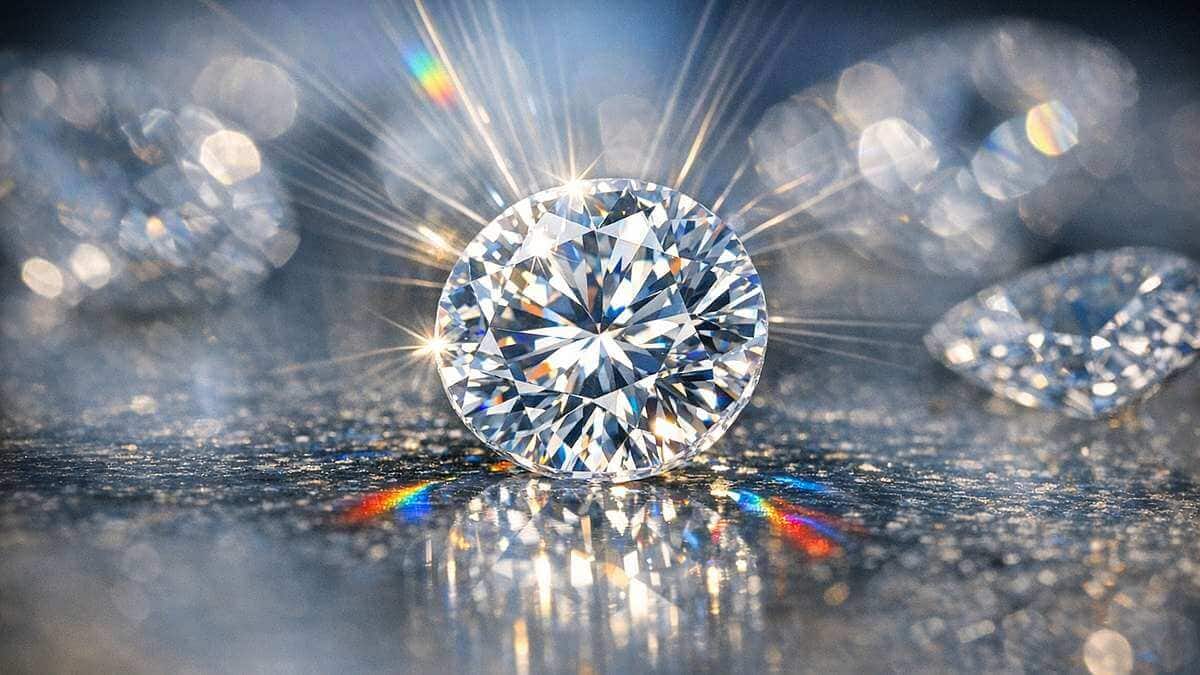
A diamond’s sparkle comes down to how it handles light.
When light enters the stone, three effects are created:
- Brilliance: white light returned to your eye
- Fire: flashes of colour
- Scintillation: sparkle as the diamond moves
At a technical level, cutters are working with the physics of light.
In simple terms, light must hit the internal surfaces of the diamond at the right angle to reflect back rather than pass through. With diamond’s high refractive index, this creates the intense brightness we associate with a well-cut stone.
You do not need to calculate this yourself, but it explains why precision matters so much.
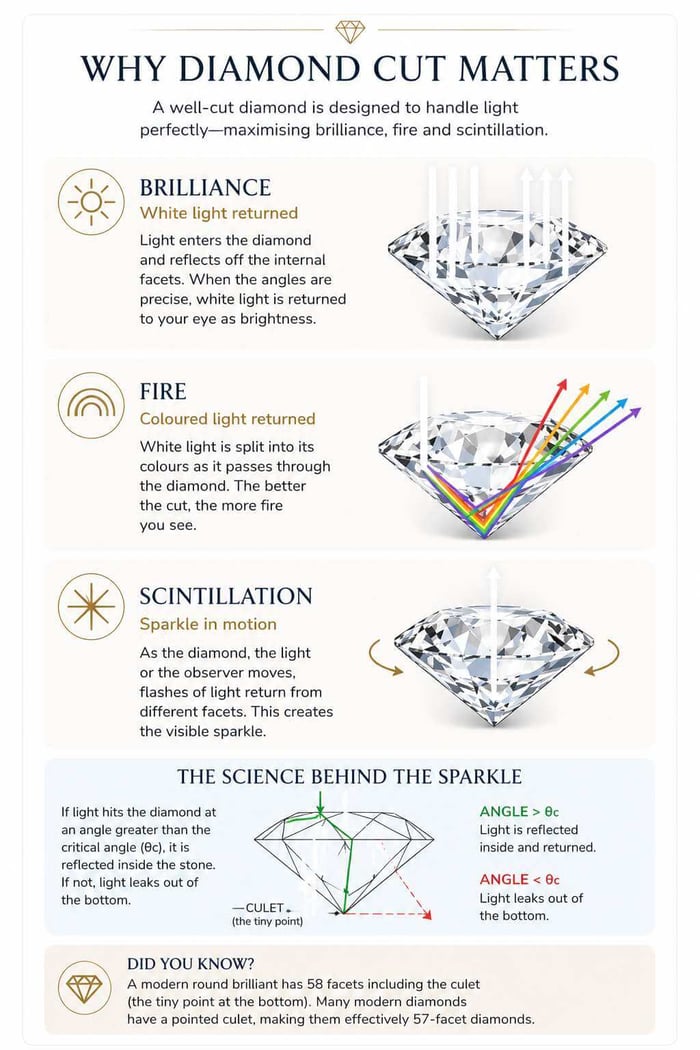
How diamond cut controls brilliance, fire, and scintillation, showing how light enters, reflects, and returns to the eye when proportions are correctly balanced.
See The Difference In Real Light
Explore well-cut lab-grown diamonds and compare how they perform across different styles and sizes.
Browse Our Diamond JewelleryThe 5 Key Steps Of Diamond Cutting
1. Planning (Mapping)
Modern cutting begins with detailed analysis. 3D scanning and AI modelling map internal inclusions and simulate different cutting options.
This is where the balance is decided. Retaining weight, improving clarity, or maximising light performance.
2. Cleaving Or Sawing
The rough stone is divided into smaller sections.
Cleaving follows natural structural lines, while sawing often uses lasers for precision. At this stage, mistakes cannot be undone.
3. Bruting (Girdling)
Traditionally, two diamonds were rotated against each other to shape the stone.
Today, lasers are also widely used in this stage, allowing for more controlled and consistent shaping.
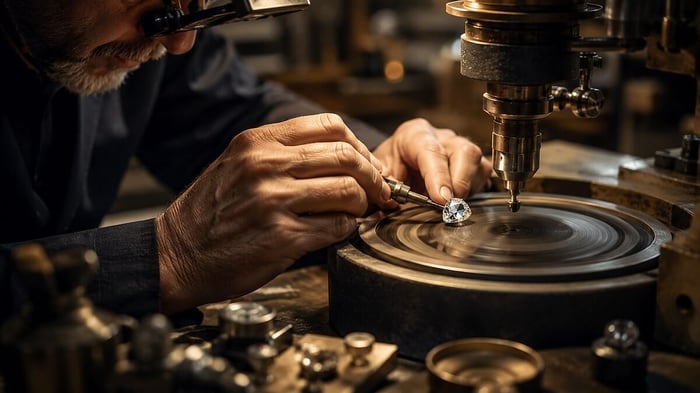
4. Faceting And Polishing
This is where the diamond begins to come alive.
- Blocking: The main facets are placed to establish structure
- Brillianteering: Additional facets are added to refine light performance
A classic round brilliant typically has 58 facets. The final facet is the culet, a tiny point at the base.
In many modern diamonds, the culet is polished to a point rather than a flat facet, meaning the stone effectively appears as a 57-facet diamond.
5. Final Inspection
The diamond is cleaned and assessed for polish, symmetry, and overall cut quality.
Only at this stage does it become a finished gemstone.
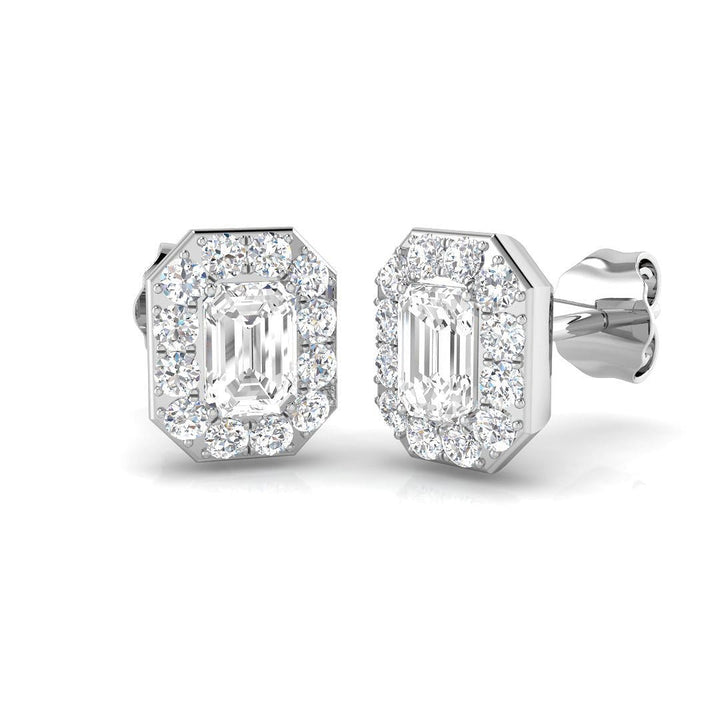
Lab Diamond Emerald Halo Earrings 1.00ct D/VVS in 925 Silver
£514.00
£995.00
These exquisite Lab Diamond Emerald Halo Earrings feature a total diamond weight of 1.00ct, ensuring elegance and brilliance. The centrepiece of each earring is a lustrous emerald-cut lab diamond, meticulously crafted to showcase its D/VVS quality. Surrounding these stunning central… read more
What This Means For You As A Buyer
A well-cut diamond does not just look brighter. It feels more alive.
The difference is immediately visible. Light returns cleanly, the sparkle feels balanced, and the stone holds your attention rather than fading in certain lighting conditions. Our article about the 4Cs of diamond quality can be read here.
This is why cut is often considered the most important of the Four Cs.
Practical Advice For First-Time Buyers
If you are choosing your first diamond, this is where clarity helps you avoid common mistakes.
- Prioritise cut quality first
Look for Excellent or Ideal cut grades where possible - Understand cut vs shape
Shape is the outline you see, such as round, oval, or pear
Cut refers to how well the facets are arranged and finished - Do not chase size alone
A smaller, well-cut diamond will usually look better than a larger, poorly cut one - Look at the diamond in real light
Sparkle is something you see, not just something listed on a certificate
For a broader view, guides such as choosing a diamond ring or understanding colour and clarity can help you balance the full picture alongside cut. Our article about buying strategies for a diamond engagment ring might be worth reading!
The Human Element Behind The Sparkle
It is easy to think of diamonds as purely natural.
In reality, the finished stone is the result of countless small decisions. Each facet is placed by design, each angle refined to control how light behaves.
That is why two diamonds can look so different even when their specifications appear similar.
One has simply been cut better.
Lab Diamond Channel Set Hoop Earrings 0.50ct in 9k Yellow Gold

£545.00
£1,035.00
Discover the allure of our Lab Diamond Channel Set Hoop Earrings, boasting a total diamond weight of 0.50ct in a captivating circle of D/VVS quality gemstones. Each diamond, meticulously chosen for its brilliance, is securely nestled in a channel setting,… read more
Final Thoughts
You do not need to understand every technical detail to choose well.
But knowing that cut controls how a diamond performs gives you a powerful advantage.
Instead of relying only on numbers, you begin to trust what you see. The brightness, the movement of light, the sense that the stone has depth and life.
That is where real value lies.
Explore Diamonds With Confidence
If you are ready to compare diamonds more closely, focus on how they perform in light, not just how they read on paper.
Browse well-cut lab-grown diamonds and see the difference for yourself.
Explore The CollectionFAQs
What is the difference between diamond cut and shape?
Shape refers to the outline of the diamond, such as round or oval. Cut refers to how well the facets are arranged, which affects sparkle and light performance.
How many facets does a diamond have?
A standard round brilliant has 58 facets including the culet, although many modern diamonds use a pointed culet, making them appear as 57 facets.
Why is cut the most important factor?
Because it controls how light behaves inside the diamond. Even high-quality stones can look dull if the cut is poor.
Are lasers used in diamond cutting?
Lasers are now widely used in both sawing and shaping, improving precision and consistency, though traditional techniques still play a role.
Can you tell a good cut just by looking?
Often yes. A well-cut diamond appears bright, lively, and balanced even without magnification.
Maya Lab Diamond Bezel Solitaire Engagement Ring 3.00ct D/VVS Platinum

£2,265.00
£10,796.00
Make a statement with the timeless Maya Lab Diamond Bezel Solitaire Engagement Ring. This stunning ring features a 3.00 carat D/VVS-graded lab-created diamond, bezel-set in platinum. Certified by IGI and UK hallmarked, this ring features a round solitaire diamond and… read more