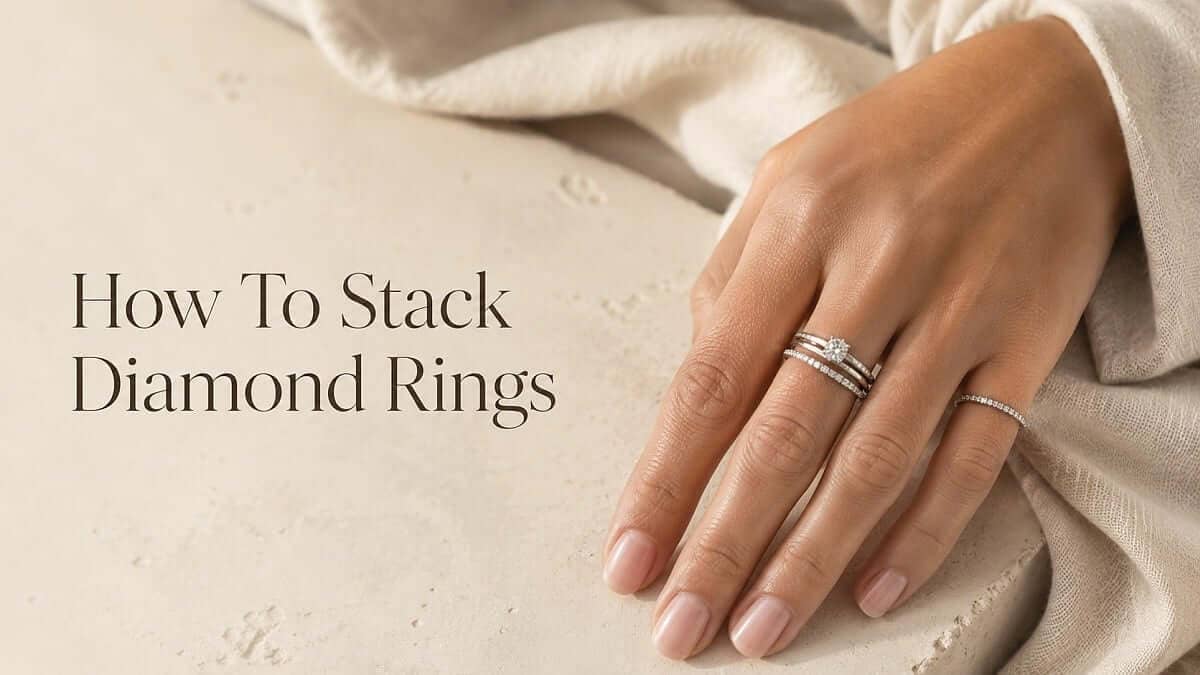

A good diamond ring stack looks as though the pieces have always belonged together. Knowing how to stack diamond rings well is less about adding more pieces than making a few quiet decisions: which ring leads, how the widths relate, whether the profiles sit together and how the whole arrangement feels once you start using your hands.
The aim is not to fit every favourite ring onto one finger. It is to make each ring improve the ones beside it. That may mean three rings in a bridal stack, two diamond bands worn together, or one small stack supported by a single ring elsewhere on the hand. Whatever the combination, balance matters more than quantity.
Quick Answer
Start with one anchor ring, then add one or two supporting bands. Use slightly different widths or textures, repeat at least one design element, and check the rings from the side as well as from above. Mixed metals are fine when the contrast looks deliberate. Most importantly, make sure diamonds, claws and metal edges are not rubbing awkwardly and that the finished stack remains comfortable when you bend your fingers, type and grip everyday objects.
A practical guide to balancing widths, metals, settings and comfort in a diamond ring stack.
Table Of Contents
- Start With An Anchor Ring
- Get The Proportions Right
- Make Sure The Rings Sit Together
- Mix Metals So The Result Looks Deliberate
- Choose Settings With Everyday Wear In Mind
- Build An Engagement, Wedding And Eternity Stack
- Spread The Stack Across More Than One Finger
- Check Comfort, Fit And Movement
- Protect The Rings From Unnecessary Wear
- Four Simple Ring Stacking Formulas
- Ring Stacking Mistakes That Are Easy To Avoid
- Build A Stack You Will Actually Wear
- Build Your Stack One Good Ring At A Time
- Frequently Asked Questions
Start With An Anchor Ring
Every successful stack needs a visual starting point. This is the anchor ring: the piece that carries the most shape, width, sparkle or personal meaning. In a bridal stack it will often be the engagement ring. In an everyday stack it might be a broader diamond band, a signet-style ring or simply the ring you wear most.
Once the anchor is clear, the other rings become easier to judge. A prominent solitaire usually benefits from quieter companions that frame the centre stone rather than compete with it. A plain wedding band can act as a visual pause. A slim half eternity ring can add light without introducing another large focal point.
There is no need for the anchor to be the most expensive ring. It only needs to be the one the eye reads first. If three rings all try to lead, the stack can look busy even when every ring is attractive on its own.
Get The Proportions Right
Band width changes the character of a stack more than many buyers expect. Three narrow rings can feel delicate and airy. Three medium or broad rings can merge into one solid block. Neither result is automatically wrong, but the total width needs to suit the finger and the way the hand moves.
A dependable starting formula is one dominant ring, one medium supporting ring and one slim finishing band. The differences do not have to be dramatic. Even a small change in width can give the stack rhythm and make the individual pieces easier to see.
Finger length matters, but comfort matters more. A longer finger may carry a deeper stack without looking crowded, while a shorter finger may feel better with two rings or with a third very fine band. Do not judge only from a close-up photograph. Look at the whole hand and check how much room remains below the first knuckle.
Make Sure The Rings Sit Together
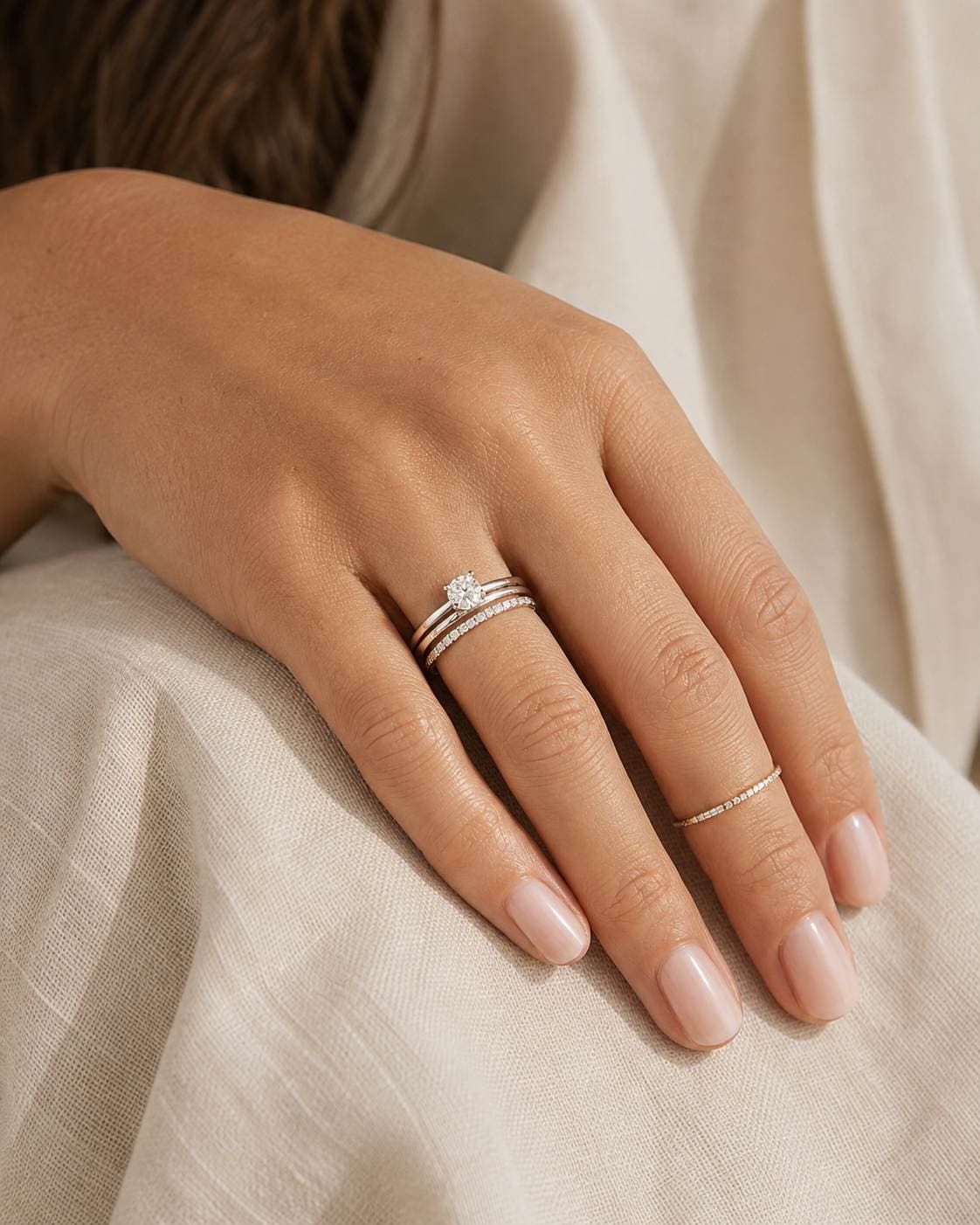
The top view tells you whether the colours and widths work. The side view tells you whether the stack is physically compatible. A low-set engagement ring may prevent a straight band from sitting close. A prominent basket, halo or cluster can push the next ring away. A curved, contoured or wishbone band may follow the outline more naturally.
A gap is not necessarily a problem. A small, even space can look intentional and can help each ring retain its identity. The warning sign is a gap created by hard contact between a claw, diamond edge or raised setting and the neighbouring ring. That contact can create wear even when the stack looks neat from above.
Before buying a companion band, compare the rings at eye level and from the side. Our guide to diamond ring settings explains how claw, pavé, channel, bezel and other settings change both appearance and everyday practicality.
See How Different Band Widths Change The Stack
Compare slim and broader half eternity rings to see how width, setting and diamond coverage alter the balance of a stack.
Mix Metals So The Result Looks Deliberate
Yellow gold beside white gold or platinum can make a ring stack feel more personal and less like a pre-matched set. The simplest way to control the look is to choose one dominant metal and use the second as an accent.
For example, a white-metal engagement ring and diamond band can be separated by one slim yellow gold wedding band. The warm line becomes a deliberate feature. If the stack feels disconnected, repeat the accent elsewhere with a small yellow gold ring on another finger or with another piece of jewellery.
Metal mixing does not remove the need to think about wear. Gold alloys and platinum behave differently, and any two rings that rub together will mark over time. The practical issue is the contact between the pieces, not whether the colours match. For a fuller comparison, see platinum versus gold jewellery in 2026.
Choose Settings With Everyday Wear In Mind
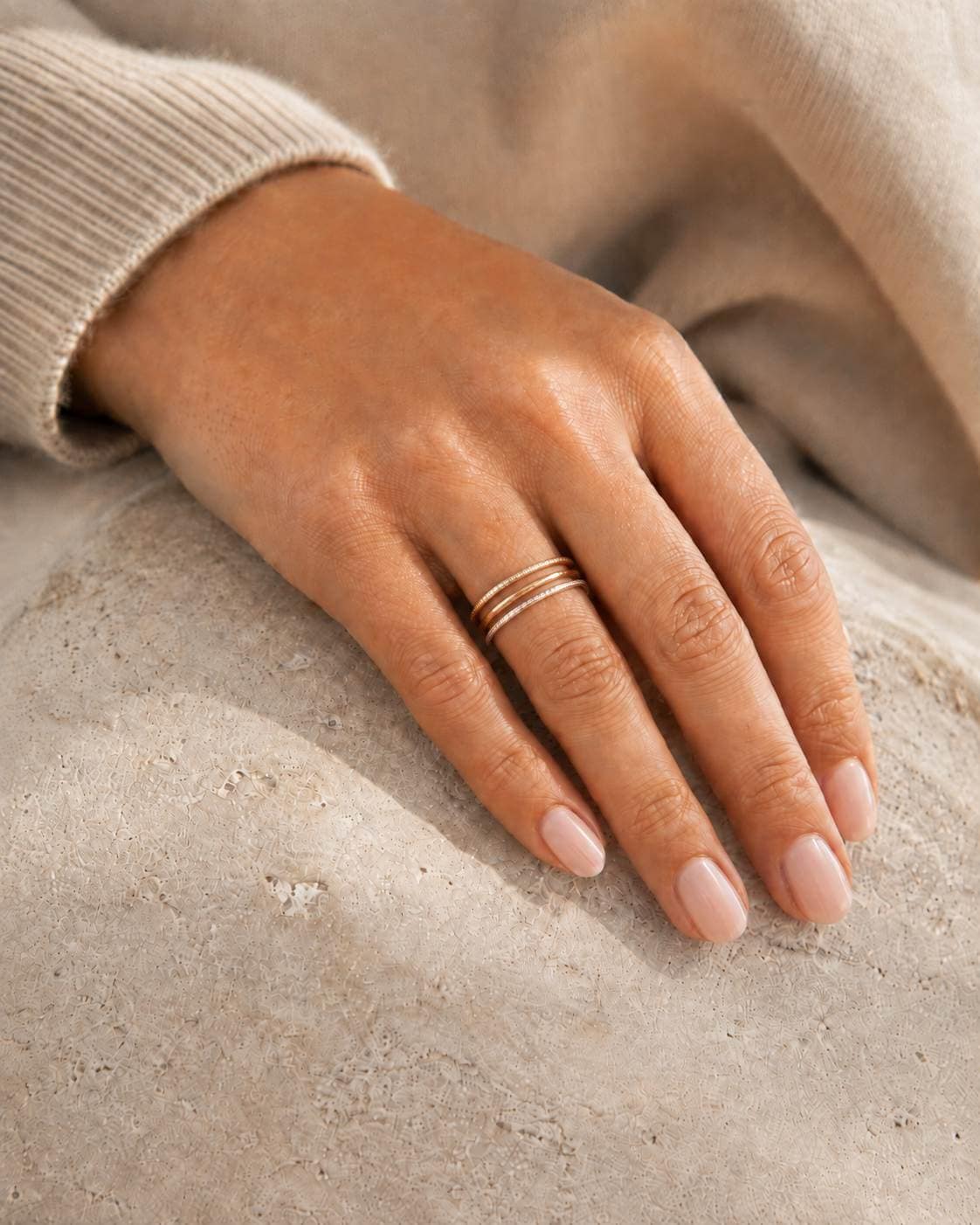
Settings affect more than sparkle. They also determine how much metal or diamond is exposed at the sides of the ring. In a stack, those outer edges are the parts most likely to touch the neighbouring piece.
Claw-set bands show more of each diamond and can create a fine, bright line. They may also have more exposed points of contact. Channel-set diamonds sit between metal walls, giving the ring a smoother outline and a more continuous band-like presence. Pavé and grain settings can be very refined, but the exact profile still needs checking because construction varies from one ring to another.
There is no single setting that is always best for stacking. The right choice depends on the rings beside it and on how active your hands are. A setting that looks delicate in a product photograph may be perfectly robust, while a visually solid ring can still have an edge that rubs. Look closely, feel the sides and ask for practical advice when combining unfamiliar designs.
Build An Engagement, Wedding And Eternity Stack
The traditional bridal order places the wedding band closest to the hand, the engagement ring next and an eternity ring on the outside. That arrangement is familiar, but it is not compulsory. Some people prefer the eternity ring between the wedding and engagement rings. Others move the engagement ring to the opposite hand or wear the eternity ring only on selected days.
Start with the two rings that already matter most, usually the wedding and engagement rings. Then decide what the third ring needs to do. It might add more diamond light, introduce a warm metal, create symmetry or mark a later milestone. It does not have to match every detail.
A half eternity band is often practical in a stack because the underside remains plain metal, which can feel smoother between the fingers and may leave more future sizing options than a fully diamond-set ring. A full eternity ring gives continuous diamonds around the finger but normally requires more exact sizing. Any alteration depends on the construction, so check before assuming a ring can be resized.
If the engagement ring has a low or unusually shaped setting, a curved or wishbone band may be the cleanest solution. A straight band and a visible gap can also work if the spacing is even and the rings are not forcing one another out of position.
Spread The Stack Across More Than One Finger
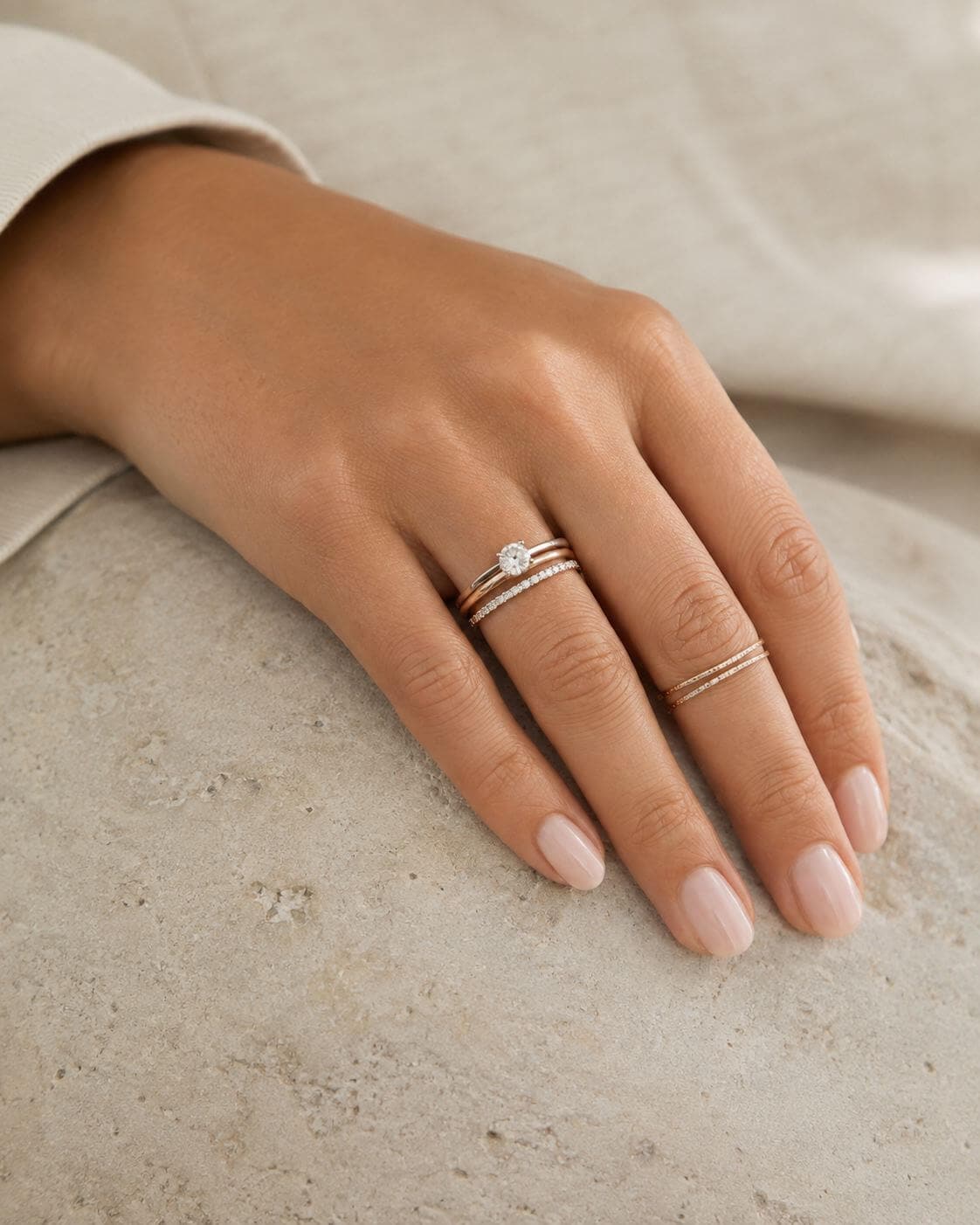
Ring stacking does not have to mean building one tall column. A two- or three-ring stack on the ring finger can be balanced by one slim band on the index, middle or little finger. Leaving at least one finger bare usually gives the eye somewhere to rest.
Keep one clear focal area. If the main stack contains a solitaire or a broader diamond band, the companion ring should normally be quieter. A fine plain band, a narrow diamond line or a small signet shape can extend the look without creating a second competing stack.
This approach is especially useful when one finger becomes uncomfortable with too much combined width. It lets you use more of your jewellery while preserving movement and a relaxed, everyday feel.
Check Comfort, Fit And Movement
A stack that looks right while your hand is flat may feel quite different once you make a fist. Put the rings on, bend every finger, type for a few minutes and grip an ordinary mug or bag handle. Pay attention to pinching between the fingers, pressure below the knuckle and any ring that is being pushed into an angle.
Several bands worn together can feel tighter than one ring because they cover more of the finger. Temperature also affects fit. Do not automatically order every new stacking ring in a larger size, but do have the whole intended combination measured if the existing rings are already snug. Our practical ring-size guide explains why the number alone is only part of the fit.
If a raised setting is rubbing another ring, a very slim plain spacer band can sometimes create useful separation. The spacer should solve a real contact problem rather than simply add another layer. If it makes the stack too wide or does not prevent contact, a shaped band or professional assessment is the better answer.
Protect The Rings From Unnecessary Wear
Diamonds are extremely hard, but a ring is a combination of diamonds, precious metal and tiny setting components. Wearing diamond-set rings directly beside one another can create scratches, worn metal or damaged edges if the pieces make persistent contact. The GIA ring stacking guide also advises buyers to consider wear when combining different metals.
Inspect a regular stack more often than rings worn alone. Look for a new gap, a rough claw, a ring that has started twisting or a polished area where two bands repeatedly touch. A professional jeweller can check the settings before a small wear point becomes a repair.
Remove stacked rings for heavy lifting, gym work, gardening and other activities that put pressure on the bands. Clean the rings individually so dirt does not remain trapped between them, and store them separately when they are off the hand. The GIA also recommends regular cleaning and professional inspection for engagement and wedding rings. Our own guide to caring for diamond jewellery covers the everyday routine in more detail.
Four Simple Ring Stacking Formulas
You do not need to copy a finished look exactly. These four formulas are useful starting structures that can be adapted to the rings you already own.
Classic bridal
One engagement ring, one plain wedding band and one slim half eternity ring. Keep the diamond band quieter than the centre stone.
Controlled mixed metal
A white-metal anchor, one narrow yellow gold band and one white-metal diamond band. Let one metal remain dominant.
Everyday band stack
One medium or broad diamond band, one smooth plain band and one very fine textured or diamond-set finishing ring.
Across the hand
One two- or three-ring focal stack plus one single fine ring on an adjacent finger, with at least one finger left bare.
Ring Stacking Mistakes That Are Easy To Avoid
The most common mistake is buying a ring because it looks right in isolation and only checking the stack from above. Side-profile compatibility should come before a perfect colour match.
It is also easy to make every band equally decorative. When all the rings have the same width, diamond coverage and visual weight, the result can become a bright block with no hierarchy. A plain or quieter band is not a compromise. It is often the element that makes the diamonds look more deliberate.
Finally, avoid building the whole stack in one purchase unless the rings were designed and fitted as a set. Adding one piece at a time lets you wear-test the combination, notice how it moves and decide what the next ring genuinely needs to contribute.
Build A Stack You Will Actually Wear
The best ring stack is not the most complicated one. It is the combination that makes sense at a glance, feels easy during an ordinary day and lets the rings you care about remain recognisable.
Begin with what you already wear. Choose the anchor, identify the missing role and add one ring that solves it. That might be a slim diamond band to bring light, a plain gold band to create contrast, a shaped ring to improve the fit or a broader channel-set design to give the stack more structure.
A stack can evolve with anniversaries, gifts and changes in personal style. There is no need to finish it all at once. In fact, the combinations that grow slowly often look the most personal because every ring has a reason to be there.
Build Your Stack One Good Ring At A Time
Explore After Diamonds lab-grown diamond rings and half eternity bands to compare widths, metals and settings. Choose the ring that adds something useful to your existing combination, then check the fit and side profile before treating the stack as complete.
Frequently Asked Questions
How many diamond rings should I stack on one finger?
Two or three rings are enough for most everyday stacks. More can work, but only when the finger has room and the rings remain comfortable, stable and visually distinct.
Can I mix yellow gold, white gold and platinum in one stack?
Yes. Mixed metals can look very considered when one metal leads and another is used as an accent. Check how the rings touch, because different metals can mark one another with repeated wear.
Which order should engagement, wedding and eternity rings go in?
The traditional order is wedding band, engagement ring, then eternity ring. Personal preference, comfort and setting compatibility matter more than the convention, so another order is perfectly reasonable.
Do stacked rings damage one another?
They can if diamonds, claws or hard edges rub against a neighbouring ring. Check the stack from the side, inspect it regularly and ask a jeweller to assess any persistent contact.
Should stacked rings be the same width?
They do not need to match. Slightly varied widths usually create better hierarchy. One dominant ring, one medium band and one slim band is a reliable starting point.
Do I need a larger ring size for a stack?
Possibly, because several bands cover more of the finger and can feel tighter. Do not guess. Have the intended combination measured together, especially if the existing rings are already snug.