
Quick Answer
In 2026, UK buyers will usually see lab-grown diamonds graded in one of two ways. Many still come with detailed 4Cs reports, commonly from IGI. GIA now uses a simpler Premium or Standard quality assessment for qualifying colourless to near-colourless lab-grown diamonds. For most first-time buyers, the practical aim is simple: choose a well-cut stone, check the report, and do not pay extra for grades you cannot see.
Lab diamond grading can look more complicated than it needs to be. You may see colour grades, clarity grades, cut grades, carat weights, report numbers, laboratory names, and now, in some cases, GIA’s Premium or Standard descriptions.
For a first-time buyer, that can make the choice feel technical before it feels personal. The good news is that grading exists to help you, not to catch you out. Once you understand what the main terms mean, a grading report becomes a useful confidence tool rather than a wall of jewellery language.
In the UK, most lab-grown diamond buyers will still come across the familiar 4Cs: cut, colour, clarity and carat. These are widely used by grading laboratories such as IGI. GIA, however, changed its approach for laboratory-grown diamonds from October 2025, moving to a broader Premium and Standard assessment for qualifying stones.
That means 2026 is a slightly unusual moment for buyers. The 4Cs still matter, but not every report presents them in exactly the same way. This guide explains what you are likely to see, what matters most, and how to choose a lab-grown diamond with more confidence.
Watch: Lab Diamond Grading In 2026
A short buyer-friendly guide to lab diamond grading, the 4Cs, GIA’s Premium and Standard assessment, and the grades that matter most when choosing a ring.
In This Article
- Why Lab Diamond Grading Matters In 2026
- The 4Cs: The Familiar Way To Compare Lab-Grown Diamonds
- What GIA’s Premium And Standard Lab Diamond Assessment Means
- Which Lab Diamond Grades Are Worth Paying For?
- Practical Checks Before You Buy
- Choose With More Confidence
- Find A Lab Diamond Ring That Feels Right
- FAQ
Why Lab Diamond Grading Matters In 2026
Grading Is About Confidence, Not Jargon
A lab-grown diamond is a real diamond grown in a controlled environment rather than formed naturally underground. Because it is a diamond, it can be assessed for the same visual and physical qualities buyers already associate with diamond grading.
The grading report helps you understand what the diamond is, how it has been assessed, and whether the seller’s description matches the stone. It should not make the purchase feel more intimidating. Its job is to give you clearer information.
For first-time buyers, grading is most useful when it answers four simple questions:
- Is the stone clearly described as laboratory-grown?
- What are its main quality characteristics?
- Which laboratory issued the report or assessment?
- Does the report number match the diamond being sold?
Once those basics are clear, you can return to the more enjoyable question: which diamond and ring design feels right?
Why Reports Do Not All Look The Same
In 2026, buyers may notice that not every lab-grown diamond report looks the same. Many diamonds are still sold with detailed 4Cs reports. Others may be described through GIA’s Premium or Standard quality assessment.
This difference does not mean one system is useful and the other is not. It means the laboratories have chosen different ways to communicate quality. IGI continues to use the familiar 4Cs language for lab-grown diamonds. GIA now uses broader descriptive terms for qualifying laboratory-grown diamonds, based on colour, clarity, polish, symmetry and cut requirements.
Buyer Note: Read The Report In Front Of You
Do not assume every laboratory uses identical presentation. Look at the report or assessment actually attached to the diamond, then ask the jeweller to explain anything unclear before you buy.
Lab Solitaire Diamond Bracelet 0.50ct D/VVS Quality in 9k Rose Gold
£665.00
£1,091.00
Make a statement with the elegant Lab Solitaire Diamond Bracelet, featuring a 0.50 carat D/VVS-certified, bezel-set solitaire diamond in 9k rose gold. The brilliant lab-grown diamond is IGI certified. The gold is UK hallmarked for quality assurance, and our lifetime… read more

The 4Cs: The Familiar Way To Compare Lab-Grown Diamonds
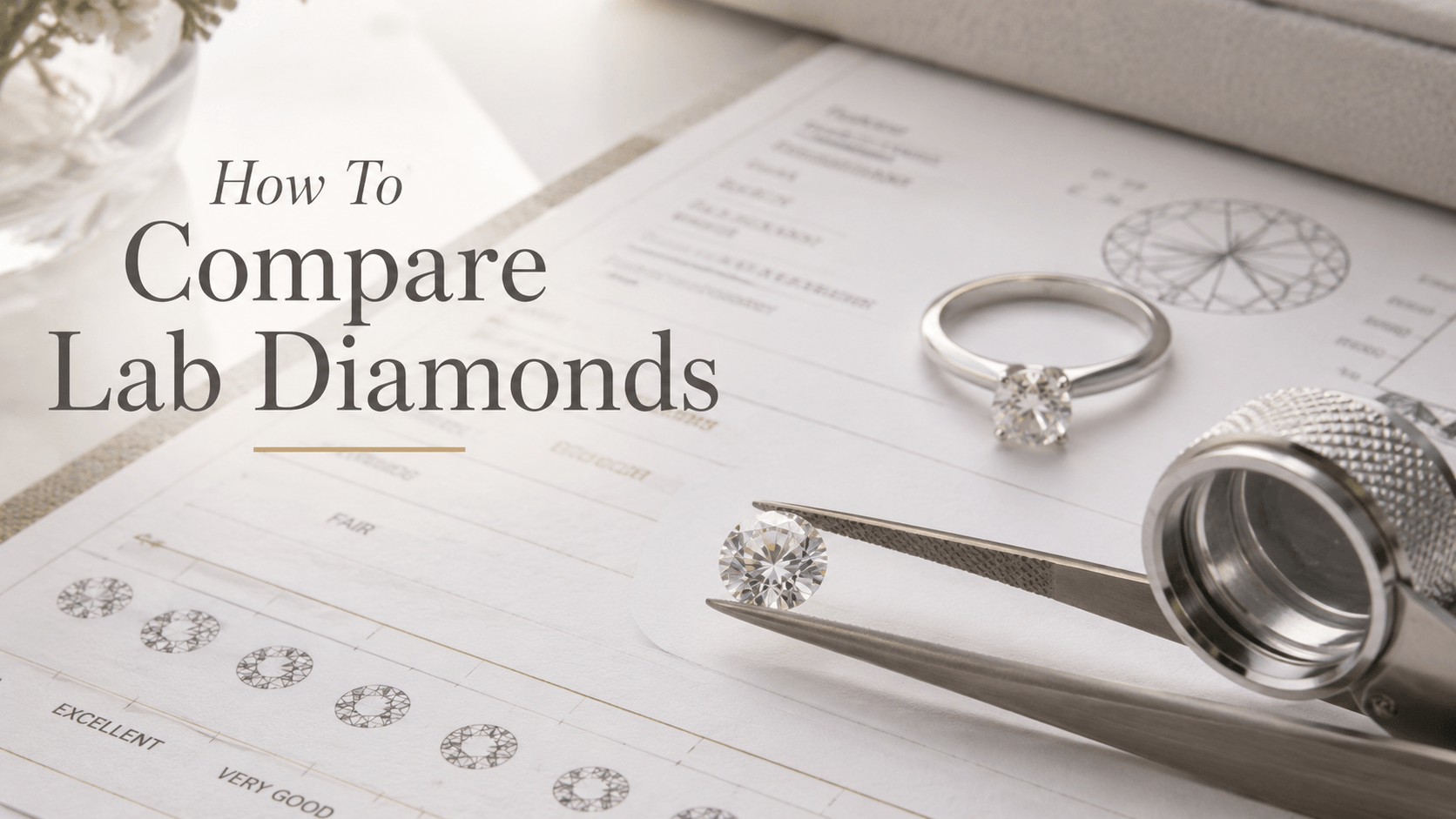
The 4Cs are cut, colour, clarity and carat weight. They are still the simplest shared language for comparing many lab-grown diamonds, especially when looking at detailed IGI-style reports.
Cut: The Grade That Most Affects Sparkle
Cut has the greatest effect on how lively a diamond looks. A well-cut diamond returns light beautifully, giving the stone brightness, fire and sparkle. A poorly cut diamond can look flat even if its colour and clarity grades appear impressive.
For round brilliant lab-grown diamonds, many buyers look for Excellent or Ideal cut grades where available. For fancy shapes, cut can be more difficult to reduce to one simple grade, so proportions, symmetry and visual appearance also matter.
Colour: How White The Diamond Appears
Traditional diamond colour grading runs from D to Z, with D being colourless. In lab-grown diamonds, high colour grades such as D, E and F are often more accessible than many buyers expect.
That does not mean every buyer must insist on D colour. E or F can also look beautifully white, especially once set in a ring. The right choice depends on budget, metal colour, diamond size and personal preference.
Clarity: What You Can And Cannot See
Clarity describes internal and external features, often called inclusions and blemishes. The highest clarity grades can sound reassuring, but they are not always necessary for a beautiful ring.
For many first-time buyers, VS1 or VS2 clarity can be a very strong value zone. These diamonds will often look clean to the eye, while avoiding the extra cost of chasing clarity details that may only be visible under magnification.
Carat Weight: Size, Weight And Proportion
Carat is a measure of weight, not the exact visible size of the diamond. Two diamonds with the same carat weight can face up differently depending on shape, cut and proportions.
This matters because a diamond should be judged as a whole. A slightly smaller diamond with a better cut, better proportions or a more flattering ring setting may be the better choice.
Maya Lab Diamond Bezel Solitaire Engagement Ring 3.00ct G/VS Platinum
£2,215.00
£5,696.00
Express your love with the timeless elegance of the Maya Lab Diamond Bezel Solitaire Engagement Ring. This stunning ring features a 3.00 carat G/VS-graded lab-created diamond, bezel-set in platinum. Certified by IGI and UK hallmarked, our craftsmen have used a… read more

Quick Grading Check: The 4Cs
Cut
Prioritise cut because it has the strongest effect on sparkle and life.
Colour
D to F gives a bright colourless look, but E or F may offer better value than insisting on D.
Clarity
VS1 or VS2 is often a sensible eye-clean choice for many buyers.
Carat
Think about size, shape and setting together, not weight alone.
For a useful independent overview of the 4Cs, see the International Gemological Institute guide to diamond grading.
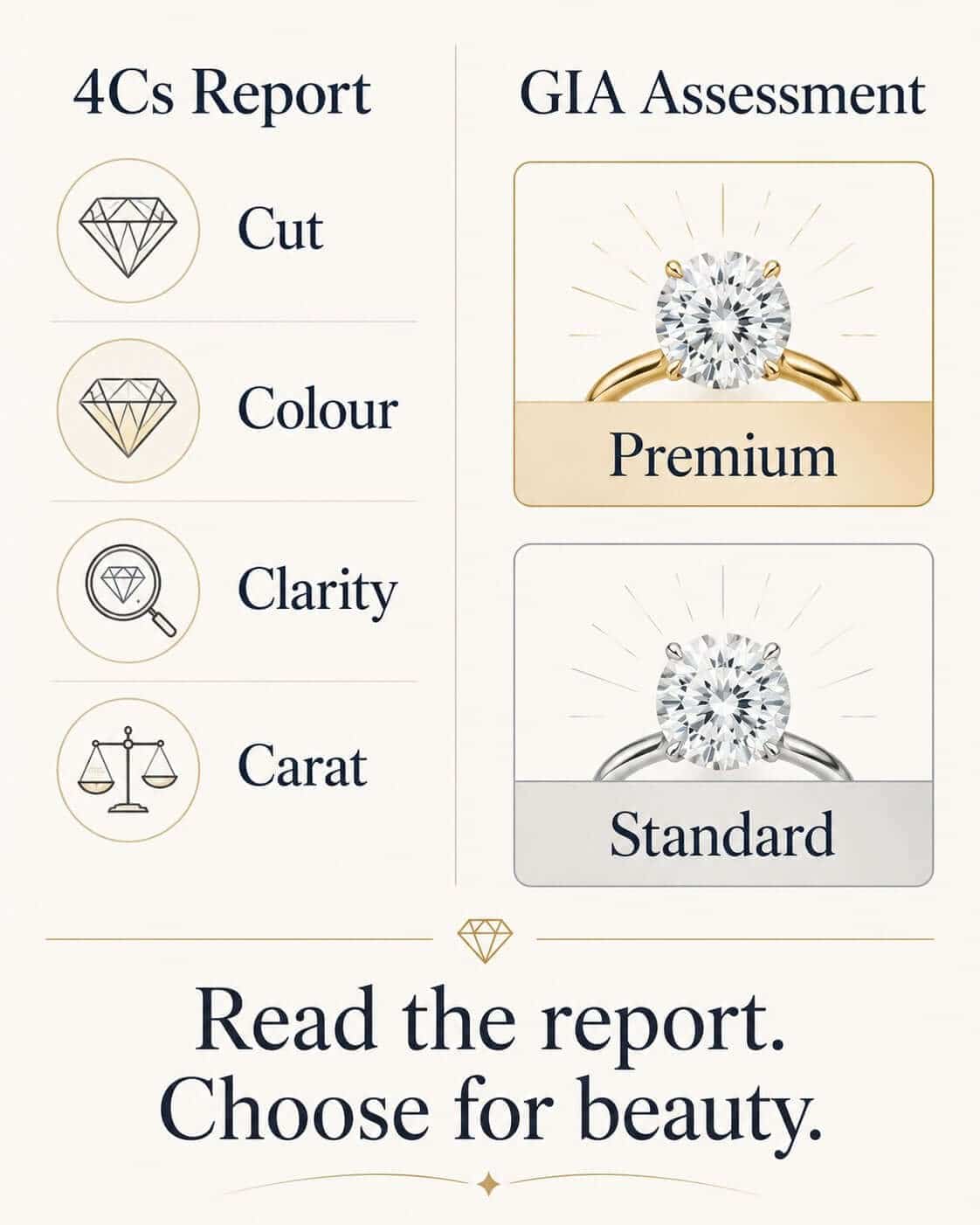
In 2026, buyers may see detailed 4Cs reports or GIA’s broader Premium and Standard lab-grown diamond assessment.
What GIA’s Premium And Standard Lab Diamond Assessment Means
GIA changed its laboratory-grown diamond reporting approach from 1 October 2025. For qualifying colourless to near-colourless lab-grown diamonds, it now gives an overall quality assessment of Premium or Standard rather than presenting the same full natural-diamond colour and clarity nomenclature buyers may already know.
GIA explains that the assessment is based on a combination of clarity, colour, polish, symmetry and cut. A stone that does not meet the minimum criteria for Standard does not receive a GIA assessment under this system.
Premium Does Not Mean Every Good Diamond Is Lesser
A GIA Premium assessment represents a lab-grown diamond meeting a high set of requirements. For example, the diamond must meet strict colour, clarity, polish and symmetry criteria, with cut requirements also applying where relevant.
However, this does not mean every diamond outside the Premium category is unattractive. Premium is a grading description, not the only route to a beautiful ring. A well-cut diamond with the right look, size and setting can still be a very satisfying purchase.
Standard Can Still Mean A Very Wearable Diamond
Standard is not a warning label. It means the diamond meets GIA’s qualifying requirements for that category. For many buyers, a Standard assessment may still describe a diamond that looks bright, clean and very wearable.
The practical point is to avoid buying on the label alone. Whether you are looking at a GIA assessment or a detailed 4Cs report, the aim is to understand the diamond clearly enough to choose with confidence.
Choosing Between Two Lab-Grown Diamonds?
Start with the diamond that looks brighter and better balanced, not simply the one with the most impressive wording. Cut, proportions and setting style can make a bigger everyday difference than a tiny clarity distinction.
You can read GIA’s own explanation of its Laboratory-Grown Diamond Quality Assessment for more detail.
Which Lab Diamond Grades Are Worth Paying For?
Because lab-grown diamond production has become more advanced, high grades are often more accessible than they once would have been. That can be good news for buyers, but it can also create a temptation to chase the top of every scale.
For many first-time buyers, a sensible starting point is:
- Excellent or Ideal cut where a cut grade is provided
- D to F colour for a bright colourless appearance
- VS1 or VS2 clarity for an eye-clean balance of beauty and value
- a recognised grading report or assessment
- a ring setting that suits real life, not just the product photograph
If the budget allows, there is nothing wrong with choosing a D colour or very high clarity diamond. The point is that you should know why you are paying for it. If the visual difference is not meaningful to you, the money may be better spent on cut quality, ring design, metal choice or a slightly larger stone.
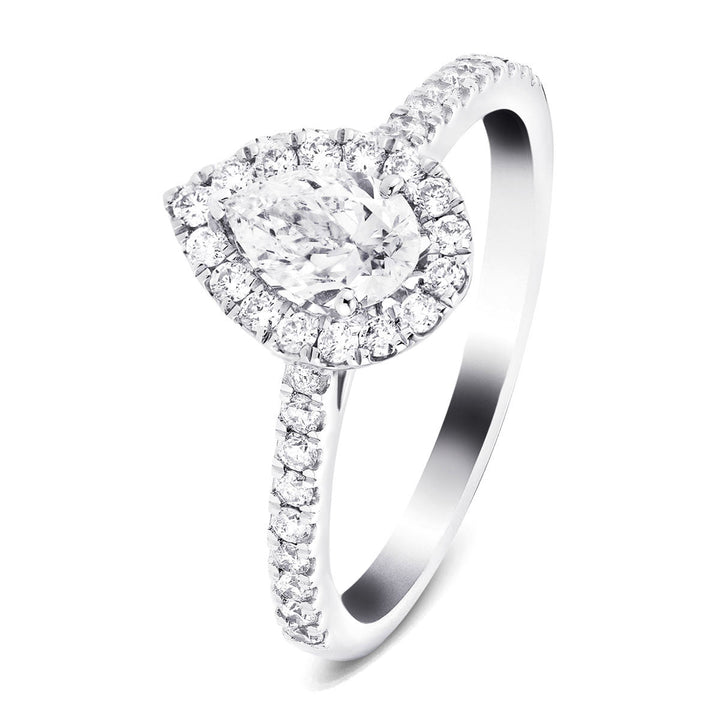
Nancy Lab Diamond Halo Pear Engagement Ring 1.10ct G/VS in 18k White Gold
£1,455.00
£2,351.00
Experience the magic of love with the Nancy Lab Diamond Halo Pear Engagement Ring, designed to dazzle your senses. This ring boasts 1.10 carats of G/VS-graded diamonds, including a pear-cut diamond at the centre surrounded by a diamond halo. There… read more
Practical Checks Before You Buy
Check The Report And The Wording
A good buying process should make the diamond’s origin clear. The stone should be described plainly as lab-grown, laboratory-grown, laboratory-created or similar. This matters because the buyer should not have to infer whether a diamond is mined or laboratory-grown.
You should also check the grading report number, the measurements, the carat weight and any inscription details where provided. If the diamond has a report number laser inscribed on the girdle, the seller should be able to explain how that connects the stone to the report.
Recent UK advertising rulings also show why clear lab-grown diamond wording matters. The safest approach for buyers and sellers is simple: avoid vague language and make the laboratory-grown origin obvious.
Do Not Buy The Certificate Instead Of The Ring
A grading report is important, but it is not the whole piece of jewellery. The ring itself still matters. Look at the setting, the proportions, the metal, the comfort and the overall design.
A diamond can have excellent paper grades and still be placed in a ring that does not suit the wearer. Equally, a diamond with sensible rather than extreme grades can look beautiful in a well-proportioned, well-made setting.
- Ask which laboratory issued the report.
- Check that the diamond is clearly described as laboratory-grown.
- Look for strong cut quality and pleasing proportions.
- Choose clarity that is clean to the eye, not only impressive on paper.
- Consider how the ring will be worn day to day.
- Buy from a jeweller who explains the details clearly.
For more background on diamond documentation, see the After Diamonds guide to lab diamond certification.
Choose With More Confidence
The best lab-grown diamond for you is not always the one with the highest possible grades. It is the one that gives you the right balance of beauty, size, sparkle, design and reassurance.
In 2026, the grading landscape may look a little more varied because IGI-style 4Cs reports and GIA’s Premium or Standard assessments can sit alongside each other in the market. That variation is manageable once you know what you are looking at.
Start with cut. Understand colour and clarity. Check the laboratory report or assessment. Then look at the ring as a whole. A diamond is chosen by grades, but it is worn as jewellery.
When the information is clear, the decision becomes calmer. You can stop worrying about whether you have missed a technical detail and start thinking about the ring you will enjoy wearing.
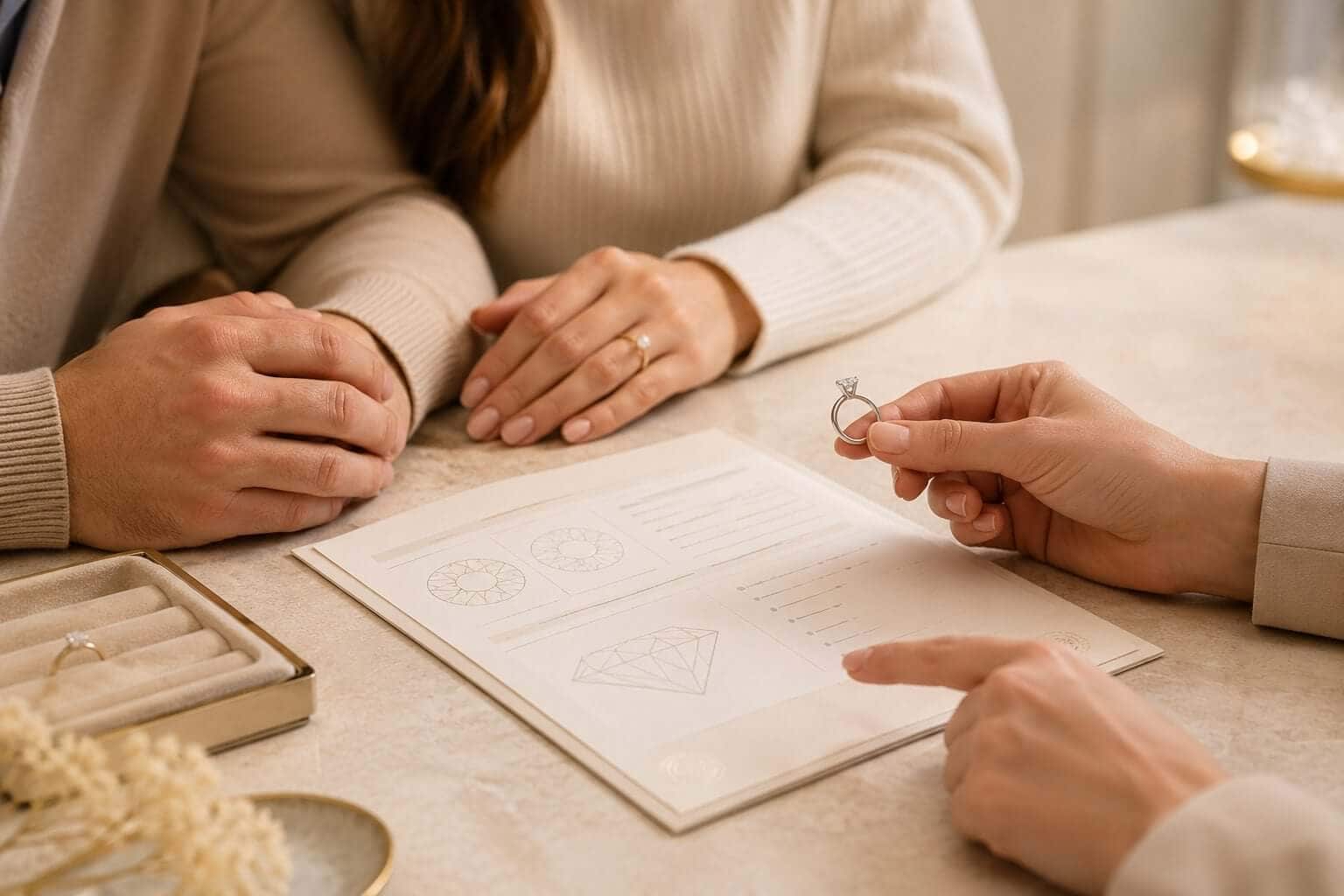 A grading report should make the buying process clearer, not more intimidating.
Find A Lab Diamond Ring That Feels Right
If you are choosing a lab-grown diamond ring, look for clear grading information, strong cut quality, a setting that suits everyday life, and a design that feels personal. After Diamonds offers lab-grown diamond jewellery selected for buyers who want beauty, value and reassurance in one purchase.
Browse the After Diamonds collection of lab diamond rings to find a piece that feels clear, considered and right for you.
Lab Diamond 1.00ct Cluster Ring D/VVS Quality in 9k Yellow Gold
£685.00
£1,315.00
Introducing the Lab Diamond 1.00ct Cluster Ring, a masterpiece of style and brilliance set in 9k yellow gold. This impressive ring features a stunning array of lab-grown diamonds, totalling 1.00ct, meticulously arranged in a round shape and securely held by… read more

FAQ
Are lab-grown diamonds graded in the same way as natural diamonds?
Many lab-grown diamonds are still sold with detailed 4Cs reports, especially from laboratories such as IGI. GIA now uses a Premium or Standard quality assessment for qualifying colourless to near-colourless laboratory-grown diamonds.
What are the 4Cs of lab diamond grading?
The 4Cs are cut, colour, clarity and carat weight. They help buyers compare how a diamond handles light, how white it appears, how clean it looks, and how much it weighs.
What does GIA Premium mean for a lab-grown diamond?
GIA Premium means the laboratory-grown diamond meets GIA’s higher assessment requirements across the relevant colour, clarity, polish, symmetry and cut criteria.
Is GIA Standard a bad grade?
No. GIA Standard means the diamond meets GIA’s qualifying requirements for that category. It should still be a bright, attractive and wearable diamond, depending on the individual stone and ring design.
What clarity should I choose for a lab-grown diamond?
VS1 and VS2 clarity are often strong choices for first-time buyers because they usually look clean to the eye while offering better value than very high clarity grades.
Should I always choose D colour?
Not necessarily. D colour is the highest colourless grade on traditional grading scales, but E or F colour can also look beautifully white, especially in a well-cut diamond and a suitable setting.
What matters most when buying a lab diamond?
Cut quality, clear lab-grown disclosure, a trusted grading report or assessment, and a ring design you love are the most important starting points.