
Quick Answer
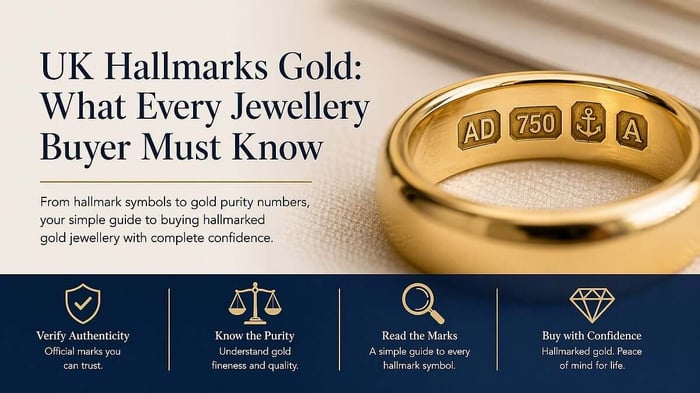
A UK gold hallmark usually includes three compulsory marks:
- Sponsor’s Mark: Who made or submitted it.
- Fineness Mark: Gold purity is indicated by numbers such as 375 or 750.
- Assay Office Mark: Which of the four UK offices tested it.
A date letter may also appear, but it is optional. Together, these marks tell you who submitted the piece for hallmarking, how pure the gold is, where it was tested, and sometimes when it was hallmarked.
When you are buying gold jewellery in the UK, the tiny marks inside a ring or on the clasp of a chain are not decorative extras. They are one of the clearest ways to check what you are being sold. Gold hallmarks are an independent confirmation of precious metal purity, and that makes it highly relevant for anyone who wants to buy with confidence rather than guesswork.
For most buyers, hallmarking matters because gold jewellery is rarely made from pure gold alone. Gold is usually alloyed with other metals to improve strength, colour, and wearability. The hallmark helps confirm that the item matches the description used at the point of sale. In practical terms, it is one of the oldest and most effective forms of consumer protection in jewellery.
You’ll discover the meanings of the numbers stamped onto almost all items of gold jewellery sold in the UK. These numbers are important consumer protection - dating back over hundreds of years.
In This Article
- What Is UK Hallmarking And Why Was It Introduced?
- A Brief History Of Hallmarking In The UK
- The Legal Requirement For Hallmarking Jewellery In The UK
- Understanding UK Gold Hallmark Symbols
- The Sponsor’s Mark
- The Fineness (Purity) Mark
- The Assay Office Mark
- The Date Letter
- Gold Hallmark Identification: What The Numbers Mean
- UK Hallmarking Exemptions
- How To Use A Gold Hallmark Identification App
- Why Hallmarked Jewellery Gives Buyers Peace Of Mind
- Browse Jewellery With More Confidence
- UK Gold Hallmark FAQs
What Is UK Hallmarking And Why Was It Introduced?
UK hallmarking is the official system used to test and certify the purity of precious metals including gold, silver, platinum, and palladium. Put simply, it exists because you cannot reliably judge metal purity by appearance alone. Two items may look similar, while differing significantly in what they are actually made from.
The purpose of hallmarking is consumer protection. It helps prevent misdescription and fraud by showing that a piece has been independently tested rather than simply described by a seller. If you want the official plain-English overview, the GOV.UK hallmarking guidance summary is one of the clearest sources.
That matters not only when buying new jewellery, but also when comparing pieces, checking value, or understanding what you may one day want to insure, resell, or pass on. A hallmark does not guarantee beauty or design quality, but it does help confirm that the metal itself matches the stated standard.
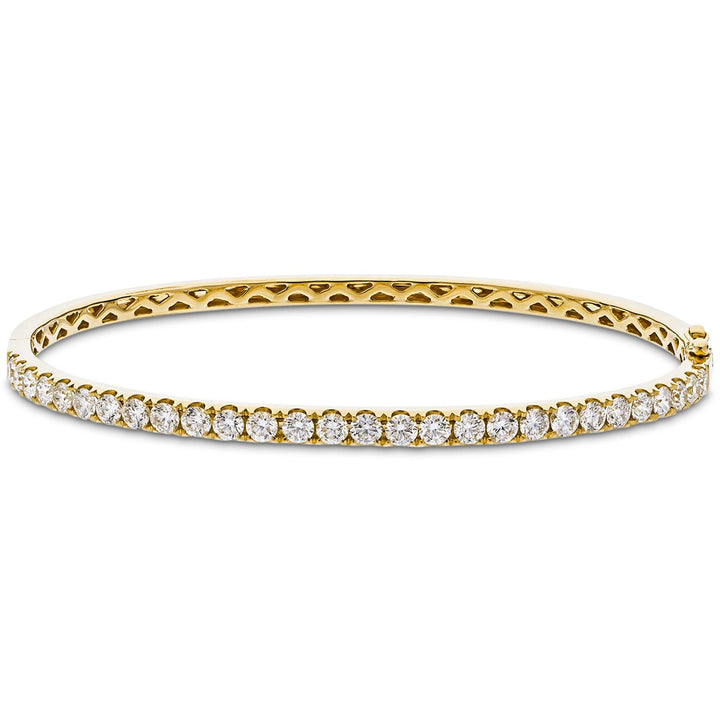
Lab Diamond Claw Set Bangle 1.00ct D/VVS in 18k Yellow Gold
£1,955.00
£3,795.00
Introducing our ethically sourced Lab Diamond Claw Set Bangle, a testament to modern elegance and tasteful design. This exquisite piece showcases 1.00ct of real diamonds, each meticulously claw-set to enhance their brilliance and ensure maximum light reflection. The diamonds, approximately… read more
A Brief History Of Hallmarking In The UK
Hallmarking in England dates back to 1300, which is why it is often described as one of the oldest forms of consumer protection in the country. Over time, the system developed through guild regulation, statutory law, and the work of the Assay Offices.
The modern framework is centred on the Hallmarking Act 1973, which consolidated and updated the law. In real terms, that means today’s system is both historic and highly practical. It is not an old custom preserved for sentiment. It is a current legal structure designed to support accurate description and fair dealing.
The Legal Requirement For Hallmarking Jewellery In The UK
In the UK, precious metal items sold as gold, silver, platinum, or palladium generally need a recognised hallmark if they are above the relevant exemption weight. For gold, that exemption is very small, which means most substantial gold jewellery should be hallmarked.
For buyers, the key point is simple: if a modern gold item is being sold as gold and it is not extremely lightweight, you would normally expect to see a hallmark. That expectation is not fussy or overly technical. It is part of buying sensibly.
Worth knowing, After Diamonds already has a useful related guide on why hallmarks are important for jewellery buyers, which sits neatly alongside the more detailed gold-specific explanation here.
Looking For Jewellery You Can Assess More Confidently?
Once you know how hallmarking works, it becomes much easier to compare pieces calmly and focus on design, metal, and wearability with a clearer eye.
Browse Our Gold Jewellery CollectionUnderstanding UK Gold Hallmark Symbols
A UK gold hallmark is easiest to understand when you break it into separate parts. Most buyers do not need to memorise every possible variation. They simply need to know what each part is there to tell them.
A modern hallmark usually includes the sponsor’s mark, the fineness mark, and the Assay Office mark. A date letter may also be present, although it is no longer compulsory. Together, these marks tell you who submitted the item for hallmarking, what standard of gold it meets, where it was tested, and sometimes when it was hallmarked.
Maya Lab Diamond Bezel Solitaire Engagement Ring 0.50ct D/VVS 18k Yellow Gold

£615.00
£1,271.00
Make a statement with the Maya Lab Diamond Bezel Solitaire Engagement Ring, a stunning symbol of love and commitment. Handcrafted in the UK, this ring is sure to capture your heart. This beautiful ring features a 0.50-carat D/VVS-graded lab-grown diamond… read more
The Sponsor’s Mark
The sponsor’s mark identifies the business or individual who submitted the article for hallmarking. It is often still casually called the maker’s mark, although the sponsor may be a manufacturer, importer, wholesaler, or retailer rather than the person who physically made the piece.
For buyers, the sponsor’s mark is useful because it adds traceability. It does not tell you the purity of the gold by itself, but it does show that a registered party stands behind the piece within the hallmarking process.
The Fineness (Purity) Mark
The fineness mark is the one most buyers find most useful straight away. This is the number that shows how much of the alloy is actually gold, expressed in parts per thousand.
In practice, the numbers most people are likely to see are:
UK Gold Fineness Marks At A Glance
- 375 = 9ct gold
- 585 = 14ct gold
- 750 = 18ct gold
- 916 = 22ct gold
What this means is that a 375 mark confirms 37.5 per cent gold, while 750 confirms 75 per cent gold. The hallmark does not tell you whether one is automatically better for every buyer. It tells you which standard you are actually paying for.
The Assay Office Mark
The Assay Office mark shows which of the UK’s authorised Assay Offices tested and hallmarked the piece. These are London, Birmingham, Sheffield, and Edinburgh. Each office has its own traditional symbol.
This matters because hallmarking in the UK is not just self-declaration by a seller. It is carried out through independent authorised offices. For a concise reference to those symbols and how they are used, the Assay Office guide to UK hallmarks is worth keeping bookmarked.
If you are comparing gold tones as well as purity, our guide to the precious metals we use to create your jewellery is a useful follow-on read.
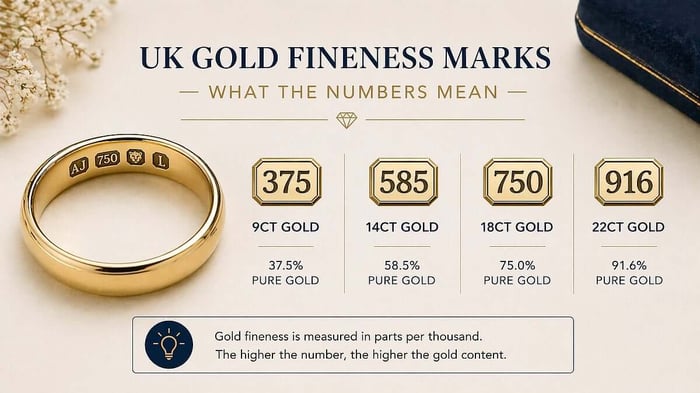 UK Gold Fineness marks explained - What the numbers mean
The Date Letter
The date letter shows the year in which an item was hallmarked, but it is now optional rather than compulsory. For many buyers of modern jewellery, that is not especially important. For antique or vintage pieces, it can be much more helpful.
If you are trying to identify or date an older piece, the date letter can provide another clue, especially when used alongside the sponsor’s mark and Assay Office mark. It is one of those details that may seem minor until you need it.
Lab Diamond Paperclip Earrings 0.55ct D/VVS in 9k Yellow Gold

£545.00
£935.00
The Lab Diamond Paperclip Earrings exude contemporary elegance, featuring a total diamond weight of 0.55ct with a D/VVS quality, masterfully set in 9k Yellow Gold. Their modern, two-link design, measuring 32.5mm in length and 6.0mm in width, is adorned with… read more
Gold Hallmark Identification: What The Numbers Mean
When buyers ask how to read a hallmark quickly, the simplest answer is to start with the number. It gives you the fastest route to understanding the gold standard involved.
For most buyers, the practical differences are not just academic. 9ct gold is often chosen for affordability and everyday practicality. 18ct gold is usually associated with a higher gold content and a more premium feel. 14ct sits between those two, while 22ct is richer in gold again but is less common in mainstream everyday jewellery.
You may also come across conversation around colour and appearance, especially when comparing white and yellow gold. If that is relevant to what you are buying, our article on white gold vs yellow gold through a real jeweller’s lens is a useful practical companion piece.
UK Hallmarking Exemptions
Not every precious metal item must be hallmarked. The main exemption most buyers are likely to encounter is the weight threshold. Very small gold items can legally fall outside the hallmarking requirement.
That helps explain why tiny gold components or extremely lightweight pieces may not always carry a hallmark, even when they are properly described. Still, most ordinary gold rings, chains, pendants, bracelets, and earrings of meaningful weight should be hallmarked.
If you want the legislative source rather than a summary, the exemption framework sits within the Hallmarking Act 1973 schedules on legislation.gov.uk.
How To Use A Gold Hallmark Identification App
Hallmark identification apps and online reference tools can be useful, especially when you are examining second-hand or inherited jewellery and trying to decode small marks quickly. They can help you identify likely fineness numbers, office symbols, and possible date letters.
Even so, it is wise to use them as reference aids rather than as final proof. A blurry image, a worn stamp, or a partially visible mark can lead to confusion. For most buyers, the smartest approach is to use an app to narrow things down and then compare the result against official hallmark guidance.
Put simply, an app can help you interpret a hallmark. It cannot replace the role of the hallmark itself.
Ava Lab Marquise Diamond Solitaire Engagement Ring 0.50ct G/VS 18k White Gold

£855.00
£1,001.00
Exude elegance with this exquisite Ava Lab Marquise Diamond Solitaire Engagement Ring, expertly crafted by hand in the UK. This ring features a gorgeous 0.50ct total weight of G/VS-graded lab-created diamonds, with a stunning marquise-cut diamond set in luxurious 18k… read more
Why Hallmarked Jewellery Gives Buyers Peace Of Mind
A hallmark gives you something highly valuable in jewellery buying: independent confirmation. It means the item is not relying on appearance or sales language alone. There is an external standard behind the description.
That is reassuring at the point of purchase, but it also matters later. It can help when you compare items, review documentation, think about insurance, or eventually pass a piece on. For research-minded buyers, that kind of clarity reduces anxiety and makes decisions feel better judged.
In real terms, a hallmark is tiny, but its value is not. It is one of the simplest signs that you are buying within a system designed to support accuracy, accountability, and confidence.
Browse Jewellery With More Confidence
Once you understand what hallmarks are telling you, it becomes much easier to assess gold jewellery with a calmer and more informed eye. You are no longer just relying on appearance or description. You have a practical way to understand what sits behind the piece.
Browse our collection at After Diamonds to explore jewellery with more clarity and confidence.
Our Collections Of Fine Jewellery Made With Gold
UK Gold Hallmark FAQs
Does all gold jewellery sold in the UK need a hallmark?
No. Very lightweight gold items can be exempt, but most substantial gold jewellery sold as gold should be hallmarked.
What does 375 mean on gold jewellery?
375 means the item is 9ct gold, containing 375 parts gold per thousand.
Is the date letter always included?
No. The date letter is optional, although it can be very useful when identifying older jewellery.
Can I trust a hallmark identification app on its own?
It is better to treat an app as a guide rather than final proof. Official hallmark references remain the safer point of comparison.
Why does hallmarking matter to ordinary buyers?
Because it helps confirm that the metal purity described at sale has been independently checked, which reduces uncertainty and supports better buying decisions. Every piece in our gold jewellery collection carries these official marks for your peace of mind.
Lab Diamond Cluster Pendant Necklace 0.25ct D/VVS in 9k Rose Gold

£385.00
£645.00
This exquisite Lab Diamond Cluster Pendant Necklace, featuring a total diamond weight of 0.25ct, is a testament to fine British craftsmanship. Each lab-created diamond is meticulously chosen for its D/VVS quality, ensuring both brilliance and clarity. Set in luxurious 9k… read more