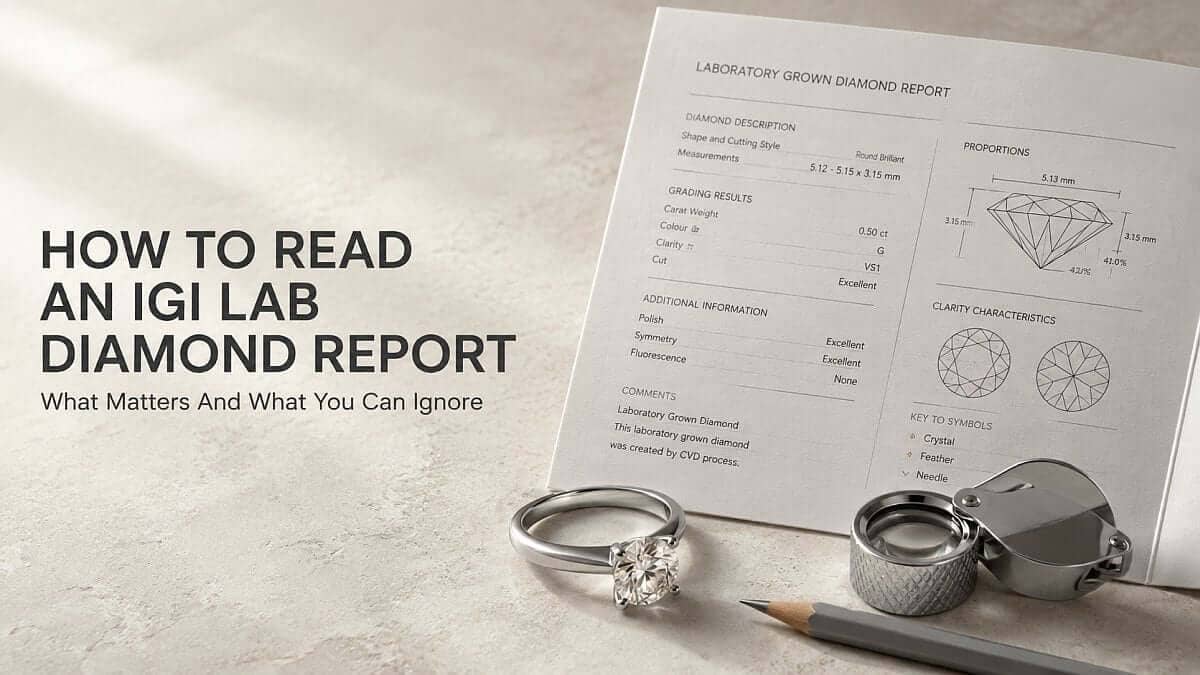

An IGI lab diamond report can look more complicated than the diamond itself. The useful part is simpler. It should confirm what the diamond is, identify the particular stone being sold and give you an independent description of its main quality characteristics.
It is evidence, not the whole buying decision. A report describes a diamond. It does not tell you whether the ring is beautifully made, whether several stones have been matched well or whether you will love the design on your hand.
Quick Answer
An IGI lab diamond report describes one specific diamond. Start by verifying the report number, then check that the document says laboratory-grown diamond and that the shape, carat weight and measurements agree with the stone being sold. Read the 4Cs in context rather than chasing the highest grades. In a ring with side stones, the report will usually apply to the centre diamond only unless the product description says otherwise. Smaller side stones and melee are still graded and carefully matched, but are not normally given individual reports.
How To Read An IGI Lab Diamond Report?
A practical guide to verifying an IGI lab diamond report, understanding the key grades and knowing why side stones are not normally certified individually.
Table Of Contents
- What An IGI Report Actually Tells You
- Does Certified Mean Every Diamond Is Certified?
- Start With Identity, Not The Highest Grade
- Read The 4Cs In The Right Order
- Polish, Symmetry, Fluorescence And Proportions
- Do Not Skip The Comments Section
- Why The Clarity Diagram Can Look Worse Than The Diamond
- What The Report Cannot Tell You
- When Is A Full Individual Report Worth Having?
- What Matters And What You Can Usually Ignore
- Choose A Ring With The Right Evidence Behind It
- Frequently Asked Questions
What An IGI Report Actually Tells You
IGI reports can record the diamond’s laboratory-grown origin, shape and cutting style, measurements, carat weight, colour, clarity and, where applicable, cut grade. They may also show polish, symmetry, fluorescence, proportions, clarity characteristics, comments and a laser inscription.
The report lets you check that the jeweller’s description agrees with an independent assessment. People often call it a certificate, but it is formally a grading report. IGI describes it as an expert opinion rather than a guarantee, appraisal or warranty.
It does not set the selling price, provide an insurance value or promise that the finished ring is well made. Use it as an independent description of a particular diamond, not as a substitute for judging the complete piece of jewellery.
IGI provides a useful official explanation of the information included in its laboratory-grown diamond reports.
Does Certified Mean Every Diamond Is Certified?
This is one of the easiest points to misunderstand.
When a multi-stone engagement ring is described as certified, that will typically mean the principal or centre diamond has its own IGI report. The smaller diamonds set along the shoulders, around a halo or beside the main stone will not normally have separate reports.
Individual reporting adds cost, and full report services are not generally intended for every very small side stone or piece of melee. A ring containing dozens of tiny diamonds would become more expensive without giving the buyer dozens of genuinely useful documents.
At After Diamonds, all diamonds used in the jewellery are graded. Individual certification is an additional level of documentation for a selected diamond, not the point at which grading begins.
The smaller stones are not unknown, ungraded or chosen at random. They are assessed within the supply system, then selected and matched by suppliers and artisans for consistency in size, colour, clarity and visual appearance.
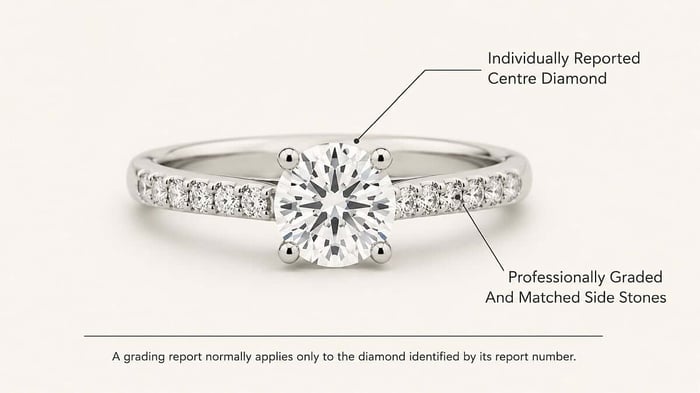
A useful way to think about it is this:
- The report describes the individually identified centre diamond.
- The stated jewellery specification describes the quality expected across the piece.
- The artisan’s matching and setting determine how well the diamonds work together visually.
Always check which stone the report refers to. Unless the product description clearly says that several diamonds are individually certified, do not assume one report covers every stone in the ring.
Design Example
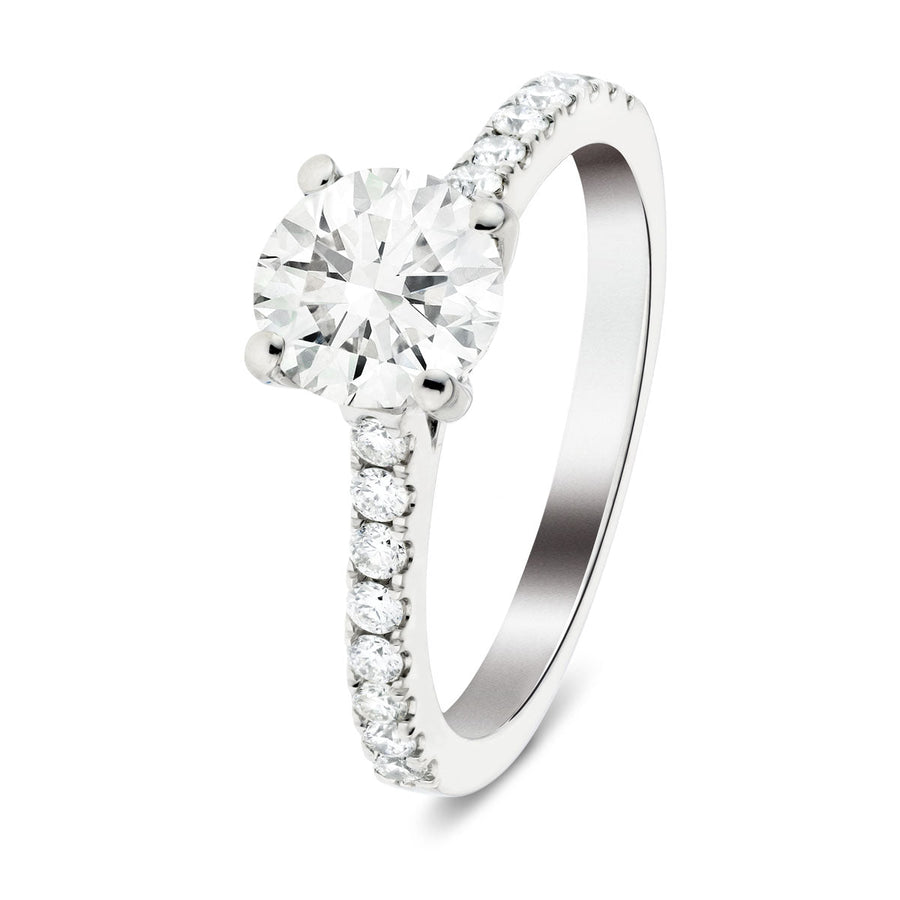
Emily Lab Diamond Round Engagement Ring
The Emily ring makes the distinction unusually clear. Its 0.50ct centre diamond is IGI certified, while a further 0.25ct of diamonds is set along the band.
The report gives detailed information about the centre stone. The finished ring also depends on the quality, consistency and setting of the supporting diamonds.
Start With Identity, Not The Highest Grade
Many buyers go straight to colour and clarity. That is understandable, but the first checks should establish that the report belongs to the diamond being offered.
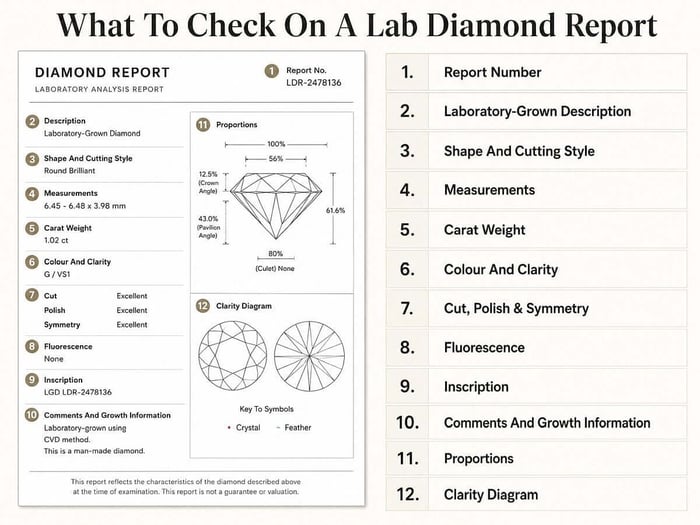
Check The Report Number
Every report has a unique number. Enter it into IGI’s online verification service or use the QR code where one is provided.
If the digital record does not correspond with the document or diamond, pause and ask the jeweller before proceeding.
Confirm The Description
The report should clearly identify the stone as a laboratory-grown diamond. Do not rely only on the shop title or a salesperson’s wording. The report itself should state the origin it records.
Match The Shape, Carat Weight And Measurements
Compare the shape, carat weight and measurements with the product description or order paperwork.
Two diamonds can have the same carat weight without looking exactly the same size from above, so dimensions provide useful context.
Look For The Inscription
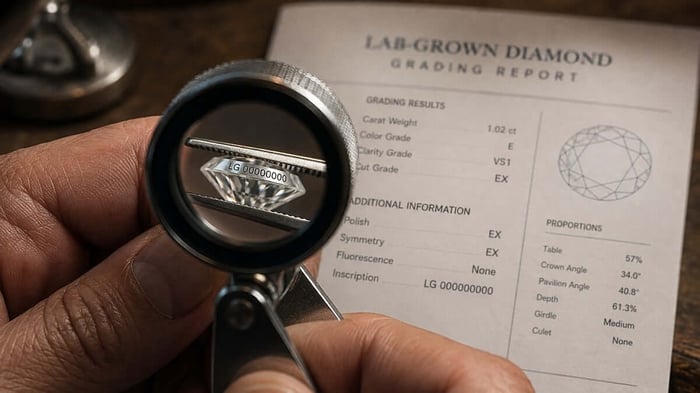
The report may list a laser inscription on the diamond’s girdle. IGI uses inscriptions to link a diamond to its report details, and a report number can be checked under magnification.
A girdle inscription is deliberately tiny and normally requires a jeweller’s loupe or microscope. Where it is listed, it should correspond with the stone.
A Clear Report Example
Ella Lab Diamond Solitaire Engagement Ring
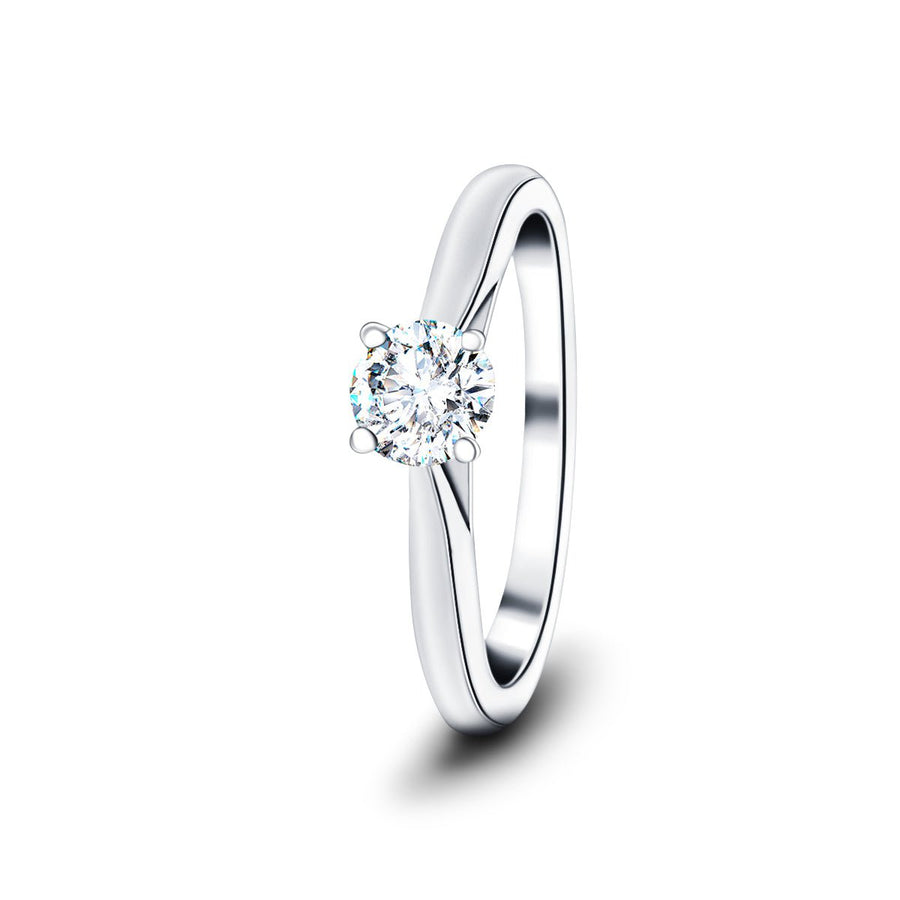
A solitaire gives you the simplest relationship between ring and report. The Ella ring has one 0.50ct G/VS focal diamond with an IGI report.
The shape, weight, quality grades and identifying details can therefore be checked directly against the stone described on the product page.
Compare Certified Lab Diamond Rings
See how report-backed centre stones are presented across different ring styles, diamond sizes and precious metals.
Read The 4Cs In The Right Order
The 4Cs still matter, but the report becomes more useful when you read them as a group rather than treating each grade as a target to maximise.
For a fuller explanation of the grading system, our guide to lab diamond grading in 2026 covers the wider context. When you have a particular IGI report in front of you, the following order is more practical.
Cut And Light Performance
For a round brilliant diamond, the cut grade is usually the first quality grade worth noticing because proportions and finish have a major influence on brightness, fire and scintillation.
Fancy shapes are assessed differently, and an overall cut grade may not appear in the same way. In those cases, polish, symmetry, proportions and the actual appearance of the diamond deserve more attention.
Cut is an important quality signal, but shape character, pattern and personal taste still matter.
Carat Weight And Measurements
Carat is weight, not a direct measurement of face-up size. Read it alongside the dimensions.
Do not reject a stone simply because another of the same carat weight measures a fraction of a millimetre wider. Complete proportions and appearance matter more than one measurement.
Colour
Colour grades tell you how close a diamond is to colourless under controlled grading conditions. They are useful for comparison, but the practical question is whether the diamond looks suitably white in its setting and alongside any other stones.
A D grade sits higher than G, but not every buyer will see a meaningful difference once the diamond is mounted. Metal colour, size and neighbouring stones also affect perception.
Clarity
Clarity is assessed under 10 times magnification. The grade records the size, nature, number, position and visibility of internal and surface characteristics at that magnification.
For the wearer, the important question is usually whether the diamond looks clean to the unaided eye. G/VS and D/VVS can both make strong jewellery choices.
One buyer may value the higher specification, while another may prefer to put more of the budget into size, metal or design.
Polish, Symmetry, Fluorescence And Proportions
These fields are worth reading, but they should not be allowed to overwhelm the main decision.
Polish describes the quality of the diamond’s finished surfaces.
Symmetry considers how accurately its facets and outline align.
Both are craftsmanship grades for the diamond itself. They do not assess the ring’s claws, shank, setting work or final finish.
Fluorescence records the diamond crystal’s reaction under ultraviolet light. It is not automatically good or bad. For most buyers, it is a point to understand rather than a reason to reject a diamond from the report alone.
A proportions diagram can show depth, table, girdle and other measurements. It helps when comparing similar diamonds, but you do not need to become an amateur cutter or obsess over every percentage in isolation.
Do Not Skip The Comments Section
The comments section often looks secondary, but it can contain some of the most useful identifying or disclosure information.
Depending on the report and service requested, comments may state the laboratory growth process, note post-growth treatment, record an inscription or add information that does not fit neatly into the main grading boxes.
CVD or HPHT describes how the diamond was grown, not an automatic quality ranking. Read any treatment disclosure and ask the jeweller for an explanation if something is unclear.
When comparing reports, include the comments rather than looking only at the large grades.
Why The Clarity Diagram Can Look Worse Than The Diamond
Where a clarity diagram is included, it maps the characteristics used during grading and identification. It is not a life-size picture of what the diamond will look like on your hand.
The assessment is made at 10 times magnification, and plotted symbols make tiny features visible on paper. A busy diagram can therefore look more dramatic than the diamond appears without magnification.
Use it for location and identification, not as a beauty score.
What The Report Cannot Tell You
A report is detailed, but it has a narrow job. It does not assess everything that makes jewellery good.
It cannot tell you:
- whether the claws are neat, secure and evenly finished
- whether the ring is comfortable and properly balanced
- whether the precious metal has been worked and polished well
- whether side stones have been matched attractively
- whether the design suits the wearer’s hand and daily life
- what insurance value should be assigned to the finished jewellery
This is why a grading report and good craftsmanship are complementary, not interchangeable. Our guide to what makes a well-made ring explains the construction and finishing details that no centre-stone report can cover.
The report can confirm the centre diamond’s characteristics. The jeweller, suppliers and artisans remain responsible for choosing suitable supporting stones and turning those materials into a coherent piece of jewellery.
When Is A Full Individual Report Worth Having?
An individual report is especially useful when a diamond is substantial enough to be a major part of the purchase decision. This commonly includes a prominent centre stone, a higher-value solitaire or another individually important diamond.
It gives the buyer a clear identity reference and independent grading information.
It is less useful to insist on a separate full report for every small diamond in a pavé band, halo, cluster, tennis bracelet or eternity ring. In those designs, grading, sorting and matching across the set are more relevant.
There are exceptions. If a design contains several substantial diamonds, the product description may state that all of them are IGI certified. The important point is not to guess. Read the wording and ask exactly how many reports are supplied.
When Several Stones Are Certified
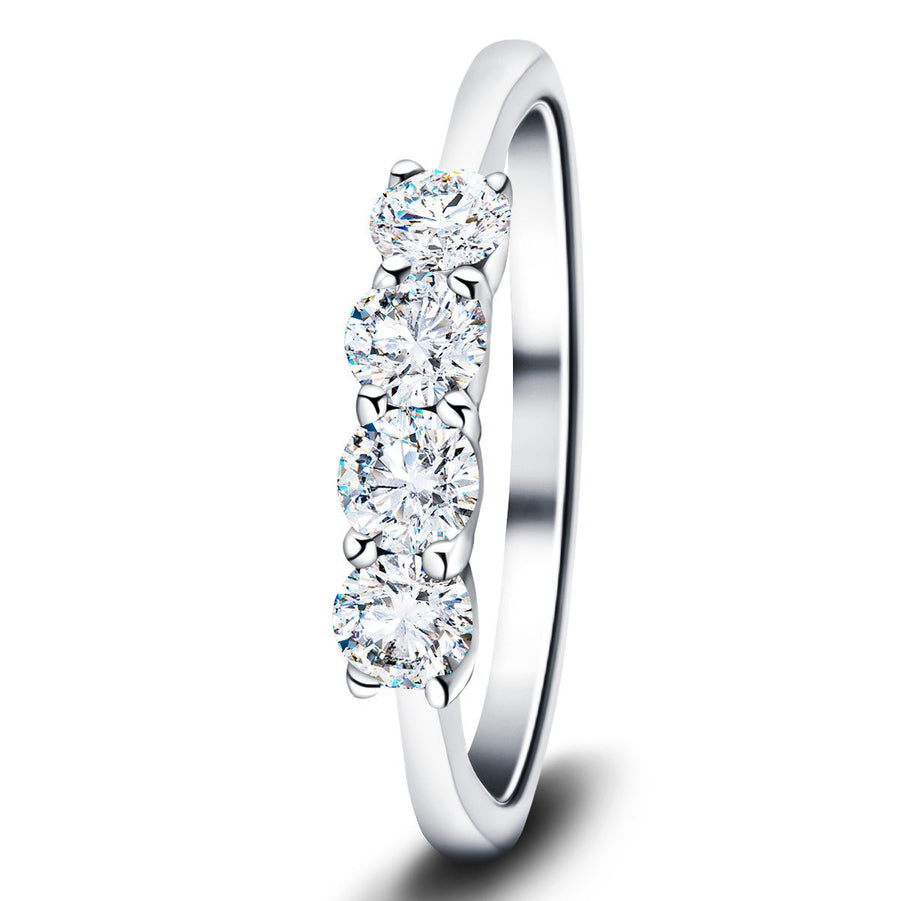
Four Stone Lab Diamond Eternity Ring
This four-stone eternity ring shows the exception clearly. Its four substantial G/VS lab diamonds are described as IGI certified and have a combined weight of 2.00ct.
When several stones are individually important, certification can reasonably extend beyond one centre diamond. The precise documentation supplied with the chosen ring should still be confirmed before purchase.
What Matters And What You Can Usually Ignore
Must Check
- The report number verifies through IGI.
- The description identifies a laboratory-grown diamond.
- You know exactly which diamond or diamonds the report covers.
- The shape, carat weight and measurements agree with the product description.
- The stated colour, clarity and cut information match what you are buying.
- The comments and inscription details do not reveal an unexplained mismatch.
Useful Context
- Polish and symmetry grades.
- Fluorescence.
- Proportions and measurements.
- The clarity diagram.
- Growth process and treatment disclosures.
- How the centre stone’s grade relates to the side stones and metal colour.
Usually Not Worth Obsessing Over
- Chasing the highest colour or clarity grade simply because it is higher.
- Treating tiny differences in measurements as a competition.
- Assuming every plotted clarity characteristic will be visible.
- Expecting every small side stone or piece of melee to have a separate report.
- Believing the report alone proves that the whole ring is well made.
The best use of an IGI report is to remove uncertainty where independent information helps, then let you judge the diamond and finished piece with clearer priorities.
Choose A Ring With The Right Evidence Behind It
A good report should make the purchase easier to understand. Check the identity details, read the grades in context and be clear about which stone the document covers. Then look at the setting, metal, matching and craftsmanship of the complete ring.
Explore Certified Lab Diamond Engagement Rings
Compare certified centre stones, diamond qualities, settings and precious metals across the After Diamonds engagement ring collection. Where a product includes an IGI report, the specification and product description will help identify what is certified, and our team can clarify the documentation supplied with a particular piece.
Frequently Asked Questions
Is An IGI Report The Same As A Diamond Certificate?
The terms are often used interchangeably in jewellery retail. IGI formally issues a grading report, which records an expert assessment of a particular diamond. It is not an appraisal, insurance valuation, guarantee or warranty.
Does A Certified Ring Mean Every Diamond Is Certified?
Usually not. In an engagement ring with a prominent centre stone and smaller supporting diamonds, the individual report will normally apply to the centre diamond. The product description should state when several diamonds are individually certified.
Are Uncertified Side Stones Ungraded?
No. Side stones and melee are still assessed and supplied within quality specifications. They are then selected and matched for size, colour, clarity and overall appearance before being set into the jewellery.
How Do I Verify An IGI Report?
Use the report number on IGI’s online verification service or scan the QR code where one is provided. Check that the digital record agrees with the paper or electronic report and the diamond being sold.
Can I See The IGI Number On The Diamond?
A laser inscription may be placed on the diamond’s girdle and listed on the report. It is extremely small and normally requires magnification to read, so you should not expect to see it with the naked eye.
Do I Need An Individual Report For Every Diamond Jewellery Purchase?
No. A report is most useful for an individually important diamond, such as a substantial centre stone. Smaller diamonds in multi-stone jewellery can be rigorously graded and matched without each receiving a separate full report.