
Quick Answer
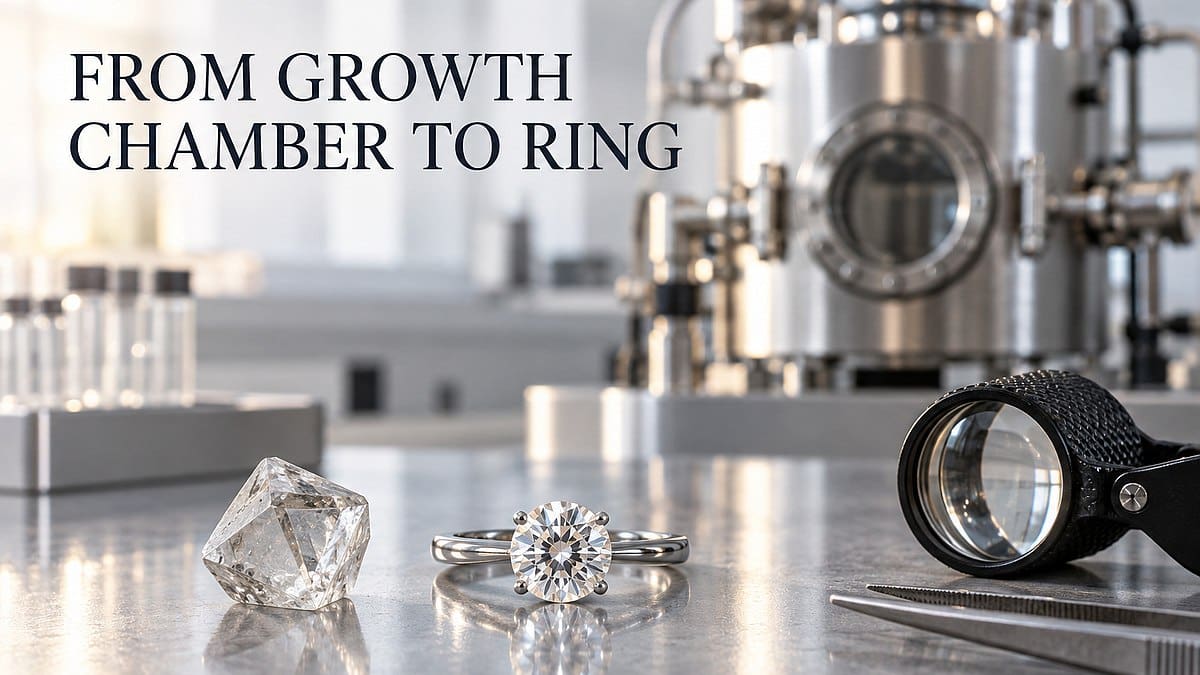
A lab-grown diamond starts with a small diamond seed. Carbon is added to that seed under controlled conditions using CVD or HPHT. The resulting rough crystal may receive a disclosed post-growth treatment before it is assessed, planned, cut and polished. A grading laboratory may then document its origin and characteristics, with a report number laser-inscribed where applicable. Finally, the jeweller selects, matches, sets and checks the stones. Each stage answers a different question, and no single stage guarantees a well-made finished piece.
Table Of Contents
- It Starts With A Diamond Seed
- CVD And HPHT Create Rough Diamond Differently
- Post-Growth Treatment Should Be Disclosed, Not Feared
- Rough Assessment Turns Growth Into A Cutting Plan
- Cutting And Polishing Create The Visible Diamond
- Grading Documents The Polished Stone
- Selection And Matching Happen After Grading
- Setting And Final Quality Control Complete The Jewellery
- What Each Stage Tells You, And What It Does Not
- From Technical Process To A Ring You Will Wear
- Frequently Asked Questions
A polished lab diamond gives few clues to the number of decisions behind it. Most short explanations stop at the growth chamber, as though a finished ring emerges at the other end. In practice, growing the crystal is only the first major stage.
Following the full lab diamond production process helps you ask better buying questions. It also prevents two common mistakes: treating the production method as a quality grade, and treating a grading report as a verdict on the whole piece of jewellery.
It Starts With A Diamond Seed
Both main growth methods begin with diamond itself. A thin seed plate provides the crystal structure on which more carbon can form as diamond. Its preparation and orientation matter to the producer, but the seed is not a miniature version of the finished gem.
It tells you how growth began. It does not tell you the eventual carat weight, colour, clarity, proportions or visual character. Those depend on the conditions during growth and on several later decisions.
CVD And HPHT Create Rough Diamond Differently
Chemical Vapour Deposition, or CVD, places prepared diamond seeds in a low-pressure chamber containing a carbon-rich gas. Energy turns the gas into a plasma, allowing carbon atoms to settle on the seeds and extend the diamond crystal layer by layer. Growth may be managed in stages, with conditions adjusted and the developing material monitored.
High Pressure High Temperature, or HPHT, uses a press to create very high pressure and temperature. Carbon dissolves in a metallic growth medium and moves towards the cooler seed, where it crystallises as diamond. The resulting rough usually has a different growth form from CVD material.
These are different manufacturing routes to the same material: diamond. They can leave different growth features that a gemmological laboratory can detect, but neither acronym is a quality grade. Good and less desirable material can result from either process. A buyer should judge the finished stone on its documented characteristics and appearance, not assume that CVD or HPHT is automatically better.
For a closer look at the two methods without turning them into a false league table, see CVD vs HPHT: Understanding Lab Diamond Creation Methods.
Post-Growth Treatment Should Be Disclosed, Not Feared
Some lab-grown diamonds receive treatment after growth to alter or improve colour. Depending on the material, this may involve further heat and pressure or another controlled process. Reputable reporting should disclose detected treatment according to the laboratory's terminology and service.
Treatment does not make a diamond an imitation, and an untreated stone is not automatically more beautiful. What matters is accurate disclosure. The growth method tells you how the crystal formed; a treatment note tells you that an additional process was used. Neither, on its own, tells you how well the finished stone will perform in jewellery.
Ready To Compare Finished Designs?
Move from process detail to proportion, setting style and everyday wearability across finished lab diamond rings.
Rough Assessment Turns Growth Into A Cutting Plan
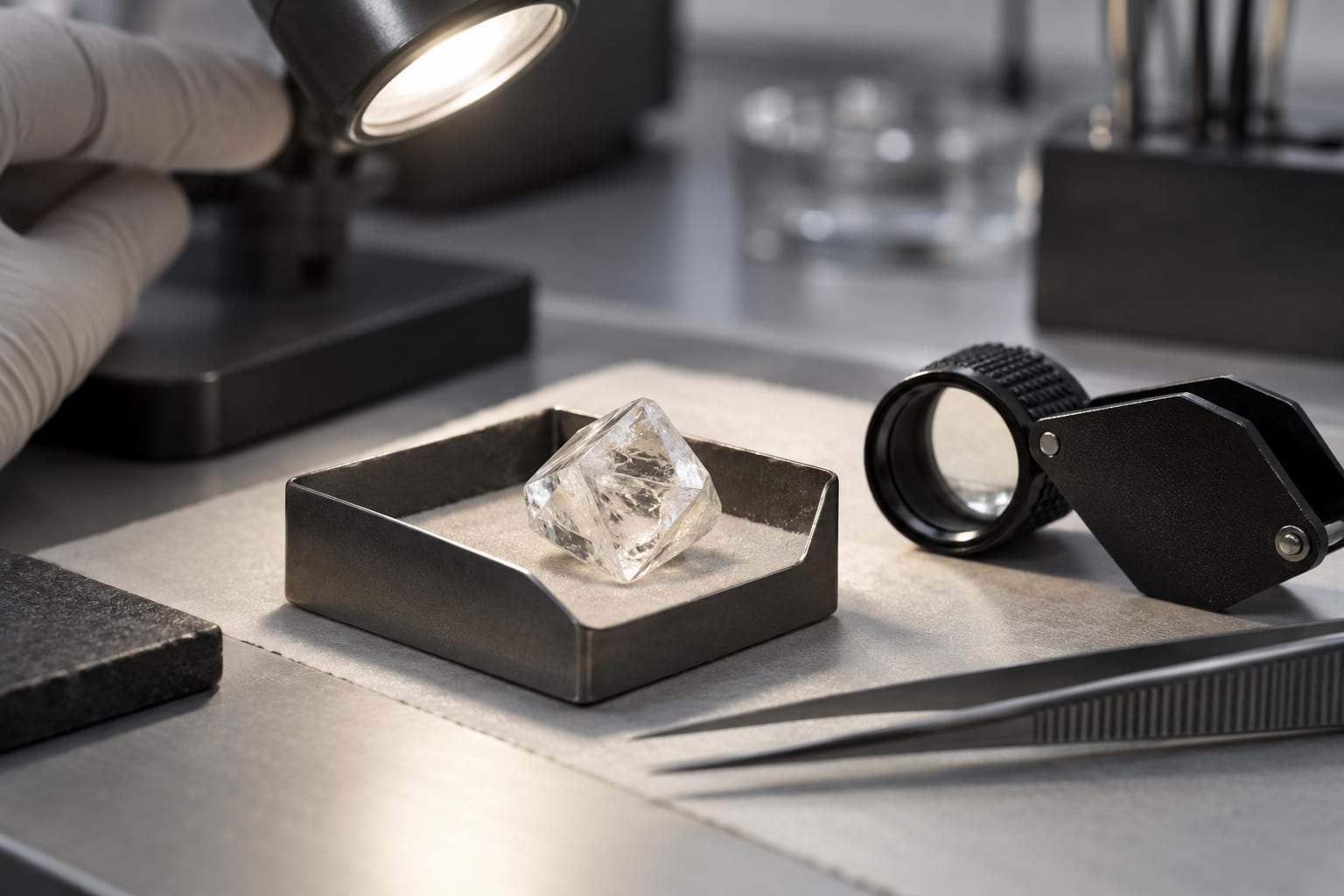
When the grown rough leaves production, it must be assessed before cutting. Planners consider its dimensions, shape, growth structure and internal features. Scanning and modelling may be used to map the material and test possible cutting plans.
This stage involves trade-offs. One plan may retain more carat weight, while another may favour a more desirable shape, better proportions or a cleaner result. The largest possible polished stone is not necessarily the best-looking one.
For the buyer, planning shows why the final diamond cannot be judged from the rough alone. The potential is there, but the cutter still has to decide what to preserve, what to remove and where the finished facets should sit.
From Planning To Finished Design
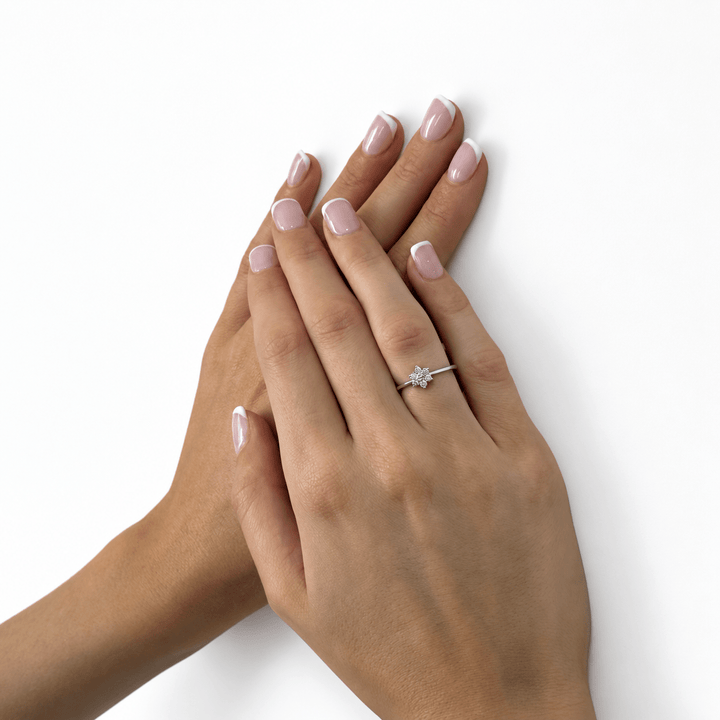
Lab Diamond 0.25ct Cluster Ring D/VVS Quality in 925 Silver
This 0.25ct total cluster of round lab diamonds shows how several stones can be selected and arranged to read as one finished design. Its product specification applies to the jewellery as offered, rather than implying a separate report for every small stone.
Cutting And Polishing Create The Visible Diamond
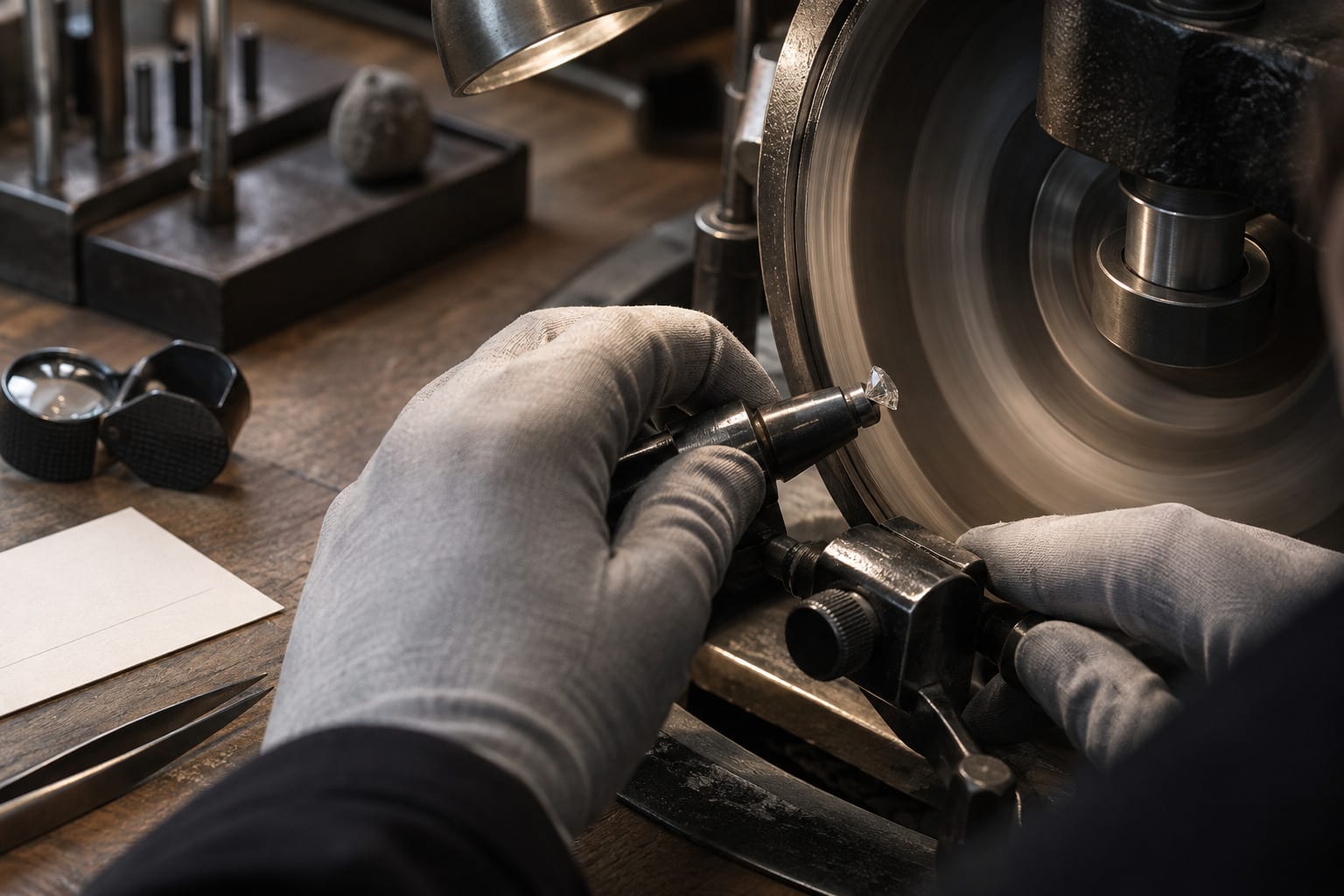
The selected plan is translated into a polished gem through a sequence that may include laser sawing, shaping the outline, forming the girdle, placing the main facets and polishing each surface. The exact sequence varies with shape and manufacturer, but the purpose is consistent: turn rough crystal into a precisely proportioned diamond.
This is where optical performance becomes more than raw-material potential. Facet angles, symmetry and polish influence how light returns to the viewer. Cutting can also remove or reposition some internal features, although it cannot simply erase every characteristic without sacrificing weight or changing the plan.
Carat weight measures mass, not cutting quality or face-up size. Two diamonds of the same weight can therefore look and perform differently. The inside story of diamond cutting explains why this stage deserves attention rather than being treated as routine finishing.
Grading Documents The Polished Stone
A loose polished diamond may then be submitted to an independent gemmological laboratory. The laboratory establishes whether it is natural, laboratory-grown or a simulant, then records the characteristics covered by the chosen service. These may include measurements, carat weight, colour and clarity assessment, cut information where applicable, polish, symmetry and fluorescence. Growth method and post-growth treatment may also appear in the report or comments, depending on the laboratory and report type.
Reporting systems are not identical. A laboratory may use conventional grades or its current descriptive framework, so read what the particular report actually says rather than assuming every document uses the same scale. Our guide to lab diamond grading in 2026 explains the current distinctions.
A grading report is an independent description of the submitted stone. It is not a valuation, a guarantee of beauty, a statement about the retail price or a quality assessment of the ring that will eventually hold it. It also does not remove the need to look at proportions and appearance together.
Where applicable, the report number and a laboratory-grown designation may be laser-inscribed on the girdle. The inscription is microscopic and is normally read under magnification. It helps connect the stone to its report, but you should still verify the report number through the issuing laboratory and check that the measurements and other details correspond. See how to read an IGI lab diamond report for a practical walk-through.
Selection And Matching Happen After Grading
A report helps a jeweller compare stones, but selection remains a separate task. For a centre stone, that may mean balancing cut, dimensions, colour, clarity, shape and budget, then checking whether the diamond looks right in real viewing conditions.
Multi-stone jewellery adds matching. Side stones and accents should work together in size, colour, brightness and overall appearance. Very small accent diamonds are commonly handled in parcels and may not each have an individual grading report. That does not mean they were ungraded in every practical sense or selected carelessly. It means the quality-control route is different.
The useful question is not simply, “Does every stone have a report?” Ask how the accent stones are screened, specified and matched, and whether the seller can explain the standard applied to the finished piece.
Selection And Matching Example
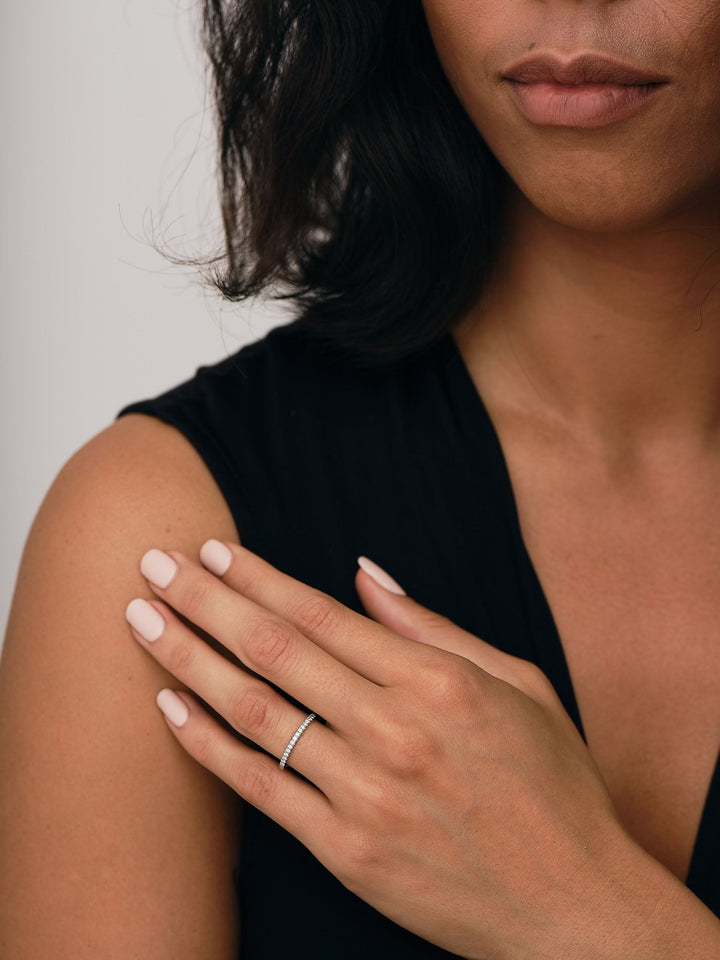
Lab Diamond 16 Stone Half Eternity Ring 0.15ct D/VVS in 9k White Gold
Sixteen round lab diamonds, totalling 0.15ct, are matched across 40% of this 9k white-gold band. It is a useful finished example of the selection and consistency required in multi-stone jewellery.
Setting And Final Quality Control Complete The Jewellery
The selected stones are then fitted to the setting. A setter prepares the seats, positions each diamond and secures it with claws, a bezel, pavé beads or another appropriate method. Alignment, spacing and the amount of metal over the stone all affect the finished appearance and security.
Final quality control should consider more than sparkle. The workshop may check that stones are secure, claws are even and smooth, pavé rows are consistent, the ring is correctly finished and the piece is clean under magnification. A well-graded centre diamond can still be let down by poor setting, just as careful workmanship can make a restrained design feel particularly resolved.
Unless the laboratory has examined the finished jewellery under a service designed for that purpose, the loose-stone report does not grade this craftsmanship. It belongs to the jeweller's manufacturing and inspection process.
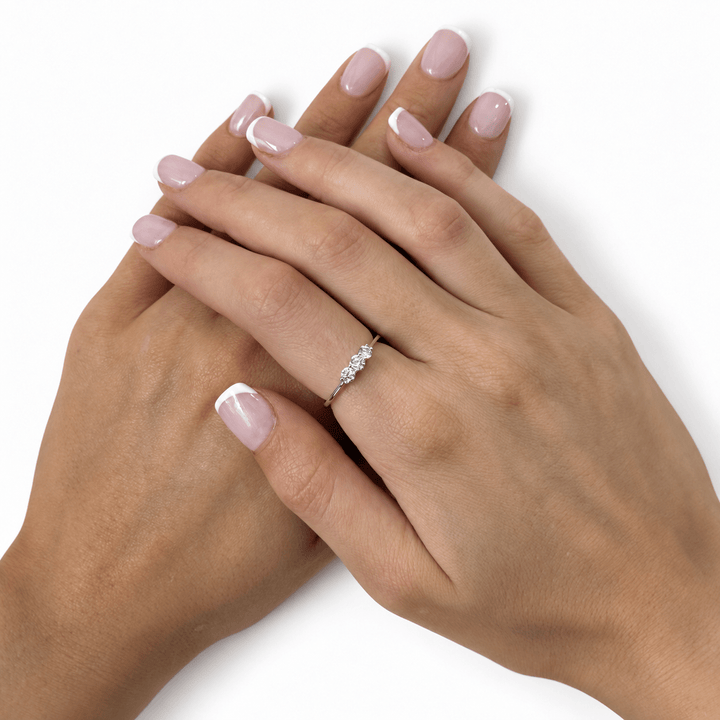
Setting And Finishing Example
Graduated Three Stone Lab Diamond Ring 0.50ct D/VVS in 9k White Gold
Three graduated round lab diamonds, totalling 0.50ct, are held in a claw setting. The design makes spacing, alignment and the relationship between stone sizes easy to inspect in the finished ring.
What Each Stage Tells You, And What It Does Not
The simplest way to read the journey is to keep each signal in its proper place:
- Seed and growth: establish the manufactured origin and growth route. They do not predict the final grade.
- Post-growth treatment: records an additional process where disclosed. It does not automatically indicate poor quality.
- Planning, cutting and polishing: determine the finished shape, weight, proportions and much of the optical result. They do not replace independent identification.
- Grading and inscription: document the examined stone and help link it to a report. They do not set its value or grade the later setting.
- Selection and matching: determine whether the chosen stones suit the design and one another. They do not require every tiny accent to carry an individual report.
- Setting and final checks: determine how securely and cleanly the jewellery is assembled. They do not change the diamond's growth origin or grading results.
In real terms, a confident purchase combines these signals. Look for clear lab-grown disclosure, suitable independent documentation for the principal stone where offered, honest treatment information, a sensible match between the report and what you can see, and credible workmanship in the finished piece.
From Technical Process To A Ring You Will Wear
The growth chamber matters, but it is not the whole story. A lab diamond becomes jewellery through a chain of specialist decisions, and each one contributes something different. The best buying approach is equally layered: understand the origin, read the documentation carefully, judge the diamond as a finished gem, then assess how well it has been selected and set.
See The Process In Finished Jewellery
Compare how cut, proportion and setting design come together once the technical stages are complete.
Frequently Asked Questions
Are Lab-Grown Diamonds Real Diamonds?
Yes. Lab-grown diamonds have essentially the same chemical, physical and optical properties as natural diamonds. They are diamonds made in controlled conditions, not diamond simulants such as cubic zirconia. Professional testing is used to distinguish laboratory-grown from natural origin.
Is CVD Or HPHT Better?
Neither method is automatically better. CVD and HPHT describe how the crystal was grown, not its final quality. Compare the polished diamond's proportions, appearance and documented characteristics rather than choosing on the acronym alone.
Does Post-Growth Treatment Mean A Diamond Is Lower Quality?
No. Treatment may be used to alter or improve colour, and it should be disclosed. Its presence is useful process information, but it does not by itself tell you whether the finished diamond is attractive, well cut or suitable for your jewellery.
Does Every Lab Diamond Have Its Own Grading Report?
No. Principal stones are often supplied with individual reports, but small accent stones may be screened, specified and matched as groups rather than reported one by one. The absence of individual reports for accents does not, by itself, imply careless selection.
What Should I Check Before Buying Lab Diamond Jewellery?
Check that the lab-grown origin is clear, review the report for the principal stone where one is supplied, note any growth-method or treatment comments, verify the report number and inscription where applicable, and assess the finished setting, stone security and seller's aftercare terms.